Introduction
Choosing the right cable management system is an important part of any electrical installation. Whether you are planning wiring for a residential building, commercial office, factory, warehouse, hospital or data centre, the way electrical cables are routed and protected can affect installation quality, maintenance requirements, safety and long-term operating costs.
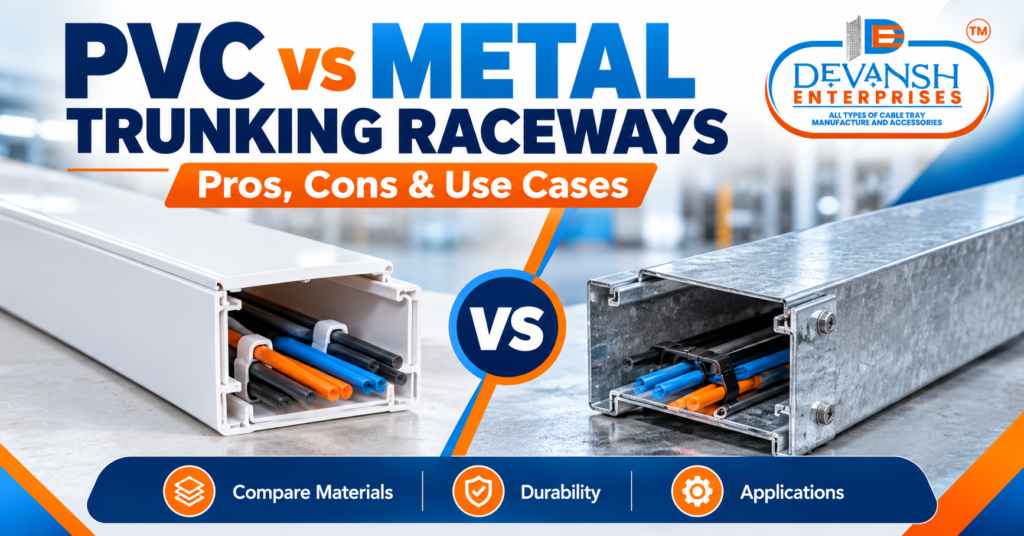
Two commonly considered options are PVC trunking raceways and metal trunking raceways. Both systems help organize electrical cables, protect wiring from external damage and create a neat installation. However, they differ significantly in terms of material properties, mechanical strength, corrosion resistance, fire performance, installation requirements and suitability for different environments.
So, which option should you choose: PVC or metal?
The answer depends on where the system will be installed, the type and quantity of cables it needs to accommodate, the surrounding environmental conditions and the level of protection required.
PVC trunking is often suitable for ordinary indoor installations where lightweight construction, corrosion resistance and easy installation are priorities. Metal trunking is frequently preferred in industrial and commercial environments where greater mechanical strength, secure containment or electromagnetic shielding may be important.
In this guide, we compare PVC vs metal trunking raceways, explore their advantages and disadvantages, explain their common applications and provide practical tips to help you make an informed decision.
What Is a Trunking Raceway?
A trunking raceway is an enclosed cable management system designed to route electrical wires, communication cables and other compatible wiring along walls, ceilings, floors or equipment structures.
Most trunking systems consist of a channel and a removable cover. The channel holds the cables, while the cover helps keep the wiring enclosed and organized.
Depending on the design, a trunking system may include partitions, bends, connectors, junction boxes and mounting components. These features help installers create organized cable routes and separate different categories of wiring when required.
Trunking raceways are commonly used in:
- Residential and apartment buildings
- Offices and commercial complexes
- Manufacturing plants and workshops
- Hospitals and educational institutions
- Retail stores and shopping centres
- Server rooms and communication facilities
- Electrical control panels and machinery installations
- Warehouses and infrastructure projects
The material used to manufacture a trunking system has a direct impact on its performance. PVC and metal are two popular choices, but neither is automatically the best option for every installation.
What Is PVC Cable Trunking?
PVC cable trunking is made from polyvinyl chloride, a widely used thermoplastic material. It is designed to enclose and organize cables while providing a lightweight, corrosion-resistant alternative to metal.
PVC systems are available in various widths, depths, colours and configurations. Smaller channels are suitable for a limited number of wires, while larger designs can accommodate more extensive cable routes when appropriately sized.
Many PVC products feature removable covers that allow electricians to access the wiring for inspection, maintenance or future modifications.
Advantages of PVC Trunking Raceways
1. Lightweight construction
PVC trunking is considerably lighter than most steel alternatives. This makes it easier to transport, handle, cut and install.
For small electrical projects or installations across multiple rooms, its lightweight construction can simplify the work involved.
2. Excellent resistance to corrosion
PVC does not rust like untreated steel. It is therefore useful in many indoor environments where humidity or occasional moisture may be a concern.
However, water exposure, chemical compatibility and the suitability of the complete installation should always be assessed before selecting a product.
3. Easy installation
PVC trunking can generally be cut and fitted using common installation tools. Depending on the design, it can also be attached to suitable surfaces using screws, clips or other specified mounting methods.
Its relatively simple installation process may reduce labour time for straightforward wiring projects.
4. Non-conductive material
PVC is electrically non-conductive under appropriate conditions. Unlike a metal enclosure, it does not require protective bonding simply because of the enclosure material.
This does not eliminate the need for proper earthing of the electrical circuits and equipment contained within the system.
5. Neat appearance
PVC trunking is available in different sizes and finishes, including white options that blend well with many interior walls and ceilings.
It is frequently used where exposed wiring needs to be concealed without significantly changing the appearance of the room.
6. Potentially lower initial cost
For basic indoor installations, PVC trunking may have a lower purchase price and require less installation effort than a comparable metal system.
Actual costs depend on dimensions, product quality, accessories, installation conditions and the amount of wiring involved.
Disadvantages of PVC Trunking Raceways
Despite its benefits, PVC has limitations that should be considered before installation.
1. Lower mechanical strength
PVC generally offers less resistance to impact and crushing than a suitably designed steel enclosure. It may crack, deform or become damaged if exposed to heavy impacts or unsuitable mounting conditions.
This can make ordinary PVC products unsuitable for exposed industrial locations where machinery, moving equipment or material handling creates a risk of physical damage.
2. Temperature limitations
PVC can soften, deform or lose performance when exposed to temperatures beyond its rated operating range.
It should not be installed close to heat-generating equipment unless the selected product is specifically suitable for those conditions.
3. Fire performance varies by product
PVC is not automatically fireproof or suitable for every fire-rated application. Its behaviour during a fire depends on the formulation, product construction and tested performance.
Where fire-rated containment or circuit integrity is required, select a system with the appropriate documented rating rather than relying on the material name alone.
4. Limited electromagnetic shielding
Standard PVC does not provide the electromagnetic shielding offered by a properly designed and bonded conductive metal enclosure.
This can matter when sensitive communication or control cables are installed near electrical equipment that produces electromagnetic interference.
5. Outdoor suitability requires verification
Ordinary PVC products may deteriorate under prolonged ultraviolet exposure or significant temperature changes.
For outdoor installations, select a product specifically rated for the expected sunlight, weather, temperature and environmental conditions.
What Is Metal Trunking Raceway?
Metal trunking raceways use materials such as steel or aluminium to form an enclosed pathway for electrical cables.
Steel systems may have galvanized, coated or other protective finishes to help resist corrosion. Aluminium offers a lighter alternative to steel in applications where its material properties and mechanical performance are suitable.
Metal trunking is widely considered for commercial and industrial installations because it can provide strong mechanical protection and a durable cable containment structure.
The exact performance depends on the metal, thickness, joint design, coating, mounting arrangement and environmental conditions.
Advantages of Metal Trunking Raceways
1. Greater mechanical protection
Metal trunking generally provides better resistance to impacts and deformation than standard PVC products of comparable purpose.
This makes it a practical option for factories, workshops, warehouses and other areas where exposed wiring may be vulnerable to physical damage.
2. Stronger structural performance
Metal systems can be suitable for installations requiring a rigid, durable enclosure, particularly when supported and installed according to the manufacturer’s specifications.
Appropriate material thickness and mounting arrangements are important for maintaining long-term performance.
3. Electromagnetic shielding
A properly designed, continuous and correctly bonded metal enclosure can help reduce electromagnetic interference affecting sensitive cables.
However, the effectiveness of shielding depends on the enclosure material, joint continuity, grounding and bonding arrangements, cable type and installation quality.
Additional separation or shielding measures may still be necessary for sensitive equipment.
4. Suitability for demanding environments
Appropriately specified metal systems can be suitable for many industrial locations, including areas exposed to higher temperatures or greater mechanical stress.
Nevertheless, the complete system must be rated for its actual operating environment.
5. Long service life in suitable conditions
When the material and protective finish are matched to the environment, metal trunking can provide durable service over an extended period.
The correct finish is especially important in humid, chemically aggressive or outdoor locations.
6. Professional industrial appearance
Metal trunking offers a robust, structured appearance that can complement electrical rooms, industrial facilities, commercial infrastructure and machinery installations.
Disadvantages of Metal Trunking Raceways
1. Higher initial investment
Metal trunking may cost more than basic PVC alternatives, particularly when thicker materials, protective finishes or specialized configurations are required.
The total project cost should include mounting hardware, connectors, bonding provisions, installation labour and maintenance.
2. Greater weight
Steel trunking is generally heavier than PVC. Transport, handling and installation may therefore require more effort and suitable support structures.
Aluminium may reduce weight, although its suitability depends on the required strength and operating conditions.
3. Grounding and bonding requirements
Metal enclosures are conductive. Their protective earthing and bonding arrangements must comply with the applicable electrical regulations and installation design.
Poor electrical continuity or inadequate bonding can create safety risks.
4. Potential corrosion
Metal can corrode when exposed to moisture, chemicals or unsuitable environmental conditions.
Protective coatings, stainless steel or other compatible materials may be required depending on the installation environment.
5. More involved installation
Cutting, joining and finishing metal trunking can require additional tools, care and skilled labour.
Sharp edges must be properly finished, and cable entry points should be protected to prevent damage to insulation.
PVC vs Metal Trunking Raceways: Key Differences
The following table summarizes the main differences between the two materials.
| Comparison Factor | PVC Trunking | Metal Trunking |
|---|---|---|
| Material | Polyvinyl chloride | Steel, aluminium or other specified metal |
| Weight | Lightweight | Generally heavier for steel |
| Initial cost | Often lower | Often higher |
| Installation | Usually straightforward | May require more tools and labour |
| Impact resistance | Moderate, product-dependent | Generally higher with suitable construction |
| Corrosion resistance | Does not rust | Depends on metal and protective finish |
| Electrical conductivity | Non-conductive | Conductive |
| Earthing and bonding | Not required solely for the PVC enclosure | Required as applicable to the system and regulations |
| Electromagnetic shielding | Not provided by standard PVC | Possible with a suitably designed and bonded enclosure |
| Temperature performance | Limited by product rating | Depends on material, finish and system design |
| Fire performance | Depends on product formulation and rating | Depends on the complete system and applicable requirements |
| Typical applications | Homes, offices and protected indoor areas | Industrial facilities, electrical rooms and demanding installations |
| Maintenance | Usually simple | May require inspection of corrosion and bonding |
Important: These are general comparisons, not universal specifications. Always review the manufacturer’s technical data and applicable electrical and fire-safety requirements before making a final selection.
PVC vs Metal Trunking: Which Is More Cost-Effective?
Cost is an important consideration for builders, electrical contractors, facility managers and project owners. However, the cheapest product at the purchasing stage is not necessarily the most economical choice over the full service life of an installation.
PVC trunking can offer savings through lower material costs, easier handling and faster installation. It is often suitable for projects where the risk of mechanical damage is limited and no special containment rating is required.
Metal trunking may involve higher upfront expenditure but can offer better value in locations where stronger mechanical protection, conductive shielding or specific fire-performance requirements are important.
To compare the actual cost of both systems, consider the following:
- Material cost per metre
- Required channel dimensions and thickness
- Number of connectors, bends and junction boxes
- Mounting brackets and support spacing
- Labour and installation equipment
- Earthing and bonding provisions
- Environmental protection requirements
- Expected inspection and maintenance costs
- Potential cost of repairs or replacement
For example, PVC may be economical for an office where cables are routed along protected walls. A metal enclosure may be a better investment in a manufacturing area where moving equipment could damage a lighter system.
The best choice is the one that meets the technical requirements without creating unnecessary installation or maintenance expenses.
Best Applications for PVC Trunking Raceways
PVC is often a suitable choice for installations that require neat cable routing, simple installation and resistance to ordinary indoor moisture.
1. Residential Buildings
PVC trunking can be used to organize exposed wiring in homes, apartments and residential complexes where concealed wiring is not practical.
It can help create a clean finish while allowing access for future maintenance.
2. Commercial Offices
Offices often require organized routes for power cables, communication wiring and compatible low-voltage systems.
PVC trunking can be useful for surface-mounted installations along walls, desks and suitable ceiling areas.
Where power and data cables share a route, appropriate segregation must be provided according to the installation design.
3. Retail Shops and Showrooms
Retail environments frequently require wiring for lighting, displays, signage, point-of-sale equipment and communication devices.
PVC trunking can help keep wiring organized and reduce visible cable clutter in suitable protected locations.
4. Educational Institutions
Classrooms, administrative offices and other protected indoor spaces may benefit from organized cable routing for computers, projectors, displays and networking equipment.
The system must be selected and installed to prevent damage from everyday use and comply with relevant safety requirements.
5. Small Commercial Renovations
During renovation projects, PVC trunking can provide a practical way to route additional wiring without extensive wall modifications.
Its suitability depends on the location, cable capacity, expected temperature and required level of mechanical protection.
Best Applications for Metal Trunking Raceways
Metal systems are commonly considered where the installation demands a stronger enclosure or requires additional technical performance.
1. Manufacturing Plants
Factories often contain machinery, electrical panels, production lines and control systems.
Metal trunking can help protect cable routes from accidental impacts and support organized wiring across suitable industrial structures.
The enclosure and its finish should be selected according to the factory’s temperature, moisture, chemical exposure and physical hazards.
2. Warehouses and Logistics Facilities
Warehouses may have forklifts, moving equipment, stacked goods and frequent material handling.
In exposed areas, a suitably designed metal system can provide stronger protection against mechanical damage. Mounting height, support spacing and vehicle-clearance requirements should also be considered.
3. Electrical Rooms
Electrical rooms may contain distribution equipment, control panels and several interconnected circuits.
Metal trunking can help organize wiring and may provide electromagnetic shielding when properly designed and bonded.
Adequate working clearances, cable separation and access for maintenance remain essential.
4. Data Centres and Communication Facilities
Data centres contain sensitive electronic equipment and extensive communication infrastructure.
Metal trunking may be useful where electromagnetic shielding is required. However, good cable routing, separation of power and data circuits, suitable cable selection and proper bonding are also important.
The material alone does not guarantee interference-free performance.
5. Industrial Workshops
Workshops may experience vibration, heat, dust, impact and frequent equipment movement.
A suitable metal enclosure can offer greater mechanical protection than ordinary PVC trunking, provided its material and finish are appropriate for the conditions.
Factors to Consider Before Choosing a Trunking System
Selecting the correct material requires more than comparing purchase prices. The following factors can help you make a more reliable decision.
1. Installation Environment
Start by identifying where the system will be installed.
Is it a clean office, a residential building, a humid service area, an outdoor location or a factory floor?
PVC may be sufficient for protected indoor environments. However, metal may be more appropriate in locations with greater physical risks. When installing trunking outdoors or in areas exposed to chemicals, verify the product’s environmental rating.
2. Type of Cables
Consider whether the trunking will carry power cables, control wiring, communication cables or a combination of different circuits.
Cable type affects the required dimensions, separation, thermal performance and shielding considerations.
Follow the applicable installation standards for segregation and cable grouping.
3. Cable Capacity and Future Expansion
The trunking should have enough internal space for the intended cable quantity and arrangement.
Overcrowding can complicate installation, restrict heat dissipation and make future maintenance more difficult.
Allow suitable capacity for planned expansion, while complying with cable-fill, temperature and electrical design requirements.
4. Temperature Conditions
Evaluate the ambient temperature and any heat generated by nearby equipment.
PVC should be used only within its specified operating limits. Metal may be more suitable in higher-temperature locations, but its coating, joints, supports and the cables themselves must also tolerate the expected conditions.
5. Risk of Mechanical Damage
Assess the likelihood of impacts, vibration, crushing or accidental contact with machinery.
Protected wall-mounted wiring may not require the same level of mechanical protection as a route exposed to forklifts or industrial equipment.
Choose the system according to the actual risk rather than assuming one material is suitable everywhere.
6. Fire and Building Requirements
Fire safety is a critical consideration in commercial and industrial projects.
Check whether the installation requires a particular fire classification, fire-resistant containment or circuit integrity during a fire.
Neither ordinary PVC nor ordinary metal trunking should automatically be treated as a fire-rated system. Use products with documented performance that meets the project’s requirements.
7. Installation and Maintenance
Consider how frequently the wiring may need inspection, repair or expansion.
A removable cover can make cable access easier, but the complete system must allow safe working clearances and proper reassembly.
For metal trunking, include inspection of protective finishes, joints and bonding continuity where required.
8. Total Project Budget
Compare the full installed cost rather than material price alone.
A system that is slightly more expensive initially may be more economical if it reduces damage, replacement or maintenance in a demanding environment.
Can PVC and Metal Trunking Be Used in the Same Project?
Yes. A project can use different trunking materials in different areas, provided the overall electrical design supports that approach.
For example, a commercial building might use PVC for protected indoor wiring and a suitable metal system in a plant room or exposed service area.
A factory could use metal enclosures along vulnerable routes while using PVC in protected locations where its performance is adequate.
When combining materials, installers should check:
- Compatibility of connectors and transition fittings
- Cable protection at entry and exit points
- Required electrical separation
- Earthing and bonding requirements
- Environmental ratings of each section
- Fire and building-code requirements
- Accessibility for inspection and maintenance
Transitions between conductive and non-conductive enclosures should be designed correctly. A qualified electrical professional should verify the arrangement before installation.
Common Mistakes to Avoid When Selecting Trunking
Even a good-quality product can perform poorly when the wrong system is selected or installed incorrectly.
Avoid these common mistakes:
Choosing only by price: A low initial price does not compensate for inadequate protection or unsuitable material performance.
Ignoring the environment: Humidity, chemicals, sunlight, heat and impact can affect different materials in different ways.
Overfilling the enclosure: Insufficient space can make cable installation and future maintenance difficult.
Ignoring fire ratings: Do not assume that a product is fire-rated simply because it is made from PVC or metal.
Neglecting bonding requirements: Conductive enclosures must have the necessary protective electrical connections.
Using unsuitable accessories: Connectors, bends, supports and covers should be compatible with the selected system.
Forgetting future expansion: Consider planned additions to avoid unnecessary replacement when more cables are needed.
Installing without technical guidance: Follow manufacturer instructions and applicable electrical regulations, especially in industrial and commercial installations.
Why Choose Devansh Enterprises for Cable Management Solutions?
Devansh Enterprises provides cable management solutions for industrial and commercial requirements. Its product range includes raceway and trunking systems, along with other cable routing products and related components.
For project owners, contractors, electrical consultants and procurement teams, selecting a suitable system involves more than choosing a material. Dimensions, material specifications, protective finish, cable capacity and installation conditions must all be considered.
When discussing your project requirements with Devansh Enterprises, be prepared to share:
- The intended application and installation location
- Required trunking width, height and length
- Preferred material and finish
- Cable type and approximate quantity
- Environmental and mechanical protection requirements
- Any relevant project specifications or compliance requirements
- Estimated quantity and delivery schedule
Providing these details can help the team understand your application and discuss suitable product options.
To explore available solutions, visit the official website: https://devanshenterpriseindia.com/
You can also contact the company through its website to discuss your project requirements and request a quotation.
Frequently Asked Questions
1. What is the main difference between PVC and metal trunking raceways?
PVC trunking is lightweight, non-conductive and resistant to rust. Metal trunking generally offers greater mechanical strength and can provide electromagnetic shielding when properly designed and bonded. The right choice depends on the installation environment and required performance.
2. Is PVC trunking better than metal trunking?
PVC can be better for protected indoor installations where low weight, easy installation and corrosion resistance are priorities. Metal may be more suitable for industrial locations requiring greater impact protection or shielding. Neither material is universally superior.
3. Is metal trunking more expensive than PVC?
Metal trunking often has a higher initial material cost and may require additional installation work. However, the overall cost depends on dimensions, finish, accessories, labour, environmental conditions and maintenance requirements.
4. Can PVC trunking be used in factories?
Yes, PVC trunking may be suitable in protected factory areas where its temperature, mechanical and environmental ratings meet the requirements. Exposed areas with significant impact risks may need a stronger alternative.
5. Does metal trunking need earthing?
Conductive metal enclosures generally require appropriate protective earthing and bonding according to the applicable electrical regulations and installation design. The connections must provide the required electrical continuity and safety.
6. Is PVC trunking suitable for outdoor use?
Some PVC products are designed for outdoor installations, but ordinary indoor products may not withstand prolonged ultraviolet exposure, weather or temperature changes. Always verify the manufacturer’s outdoor suitability and environmental ratings.
7. Which trunking is suitable for data cables?
Both materials can be used for data cabling when the complete system meets the installation requirements. Metal may help with electromagnetic shielding when properly designed and bonded. Cable separation, routing, cable specifications and equipment requirements must also be considered.
8. How do I select the correct trunking size?
Determine the number and type of cables, their dimensions, applicable cable-fill requirements, thermal considerations and expected future expansion. Consult the installation design and manufacturer specifications before finalizing the size.
9. Can PVC and metal trunking be installed together?
Yes. Different materials can be used in separate sections of a project when the design accounts for transitions, cable protection, environmental conditions and electrical safety requirements.
10. Where can I enquire about trunking solutions for a project?
You can visit the official Devansh Enterprises website at https://devanshenterpriseindia.com/ to review its cable management offerings and contact the company about your project specifications.
PVC vs Metal Trunking: Which Should You Choose?
The right choice depends on the installation environment, cable requirements and level of protection needed. PVC is often suitable for protected indoor installations where lightweight construction and easy handling are priorities. Metal is often worth considering where greater mechanical protection or electromagnetic shielding is required.
Before selecting either option, assess the operating temperature, risk of physical damage, moisture exposure, cable capacity, fire-performance requirements and applicable electrical regulations.
Quick Selection Guide
| Project requirement | Suitable starting point | What to check |
|---|---|---|
| Protected residential wiring | PVC | Product rating, dimensions and appearance |
| Office renovations | PVC or metal | Cable capacity, accessibility and impact risk |
| Factory production areas | Metal may be preferable | Mechanical protection, temperature and corrosion |
| Humid environments | Either, subject to specification | Environmental suitability and protective finish |
| Sensitive control wiring | Metal may be worth considering | Shielding performance, bonding and cable separation |
| Outdoor installations | Environment-rated product | UV resistance, moisture, temperature and corrosion |
PVC vs Metal Trunking: Technical Factors Engineers Should Evaluate
Material selection should be based on the complete installation rather than on a general assumption that one material is always superior.
Mechanical strength and enclosure design
The strength of a trunking system depends on its material, wall thickness, dimensions, cover design, joints and mounting arrangement. Metal enclosures generally provide better resistance to impact than standard PVC products, but the actual performance must be verified against product specifications.
Cable heating and enclosure capacity
The number of cables installed inside a trunking system can affect heat dissipation and cable current-carrying capacity. Cable grouping, ambient temperature, conductor size and the applicable electrical design rules must be considered when determining enclosure dimensions and permissible cable loading.
Corrosion and environmental exposure
PVC does not rust, but it can be affected by ultraviolet radiation, temperature and certain chemicals. Metal systems may require an appropriate coating or corrosion-resistant alloy. The correct specification depends on the actual environment rather than the material category alone.
Earthing, bonding and electromagnetic compatibility
Metal enclosures may provide electromagnetic shielding when the enclosure has suitable electrical continuity and bonding. Conductive enclosures must also comply with the relevant protective earthing requirements. PVC is non-conductive, but additional shielding or separation may still be necessary for sensitive installations.
Fire performance and compliance
The suitability of a trunking product for a particular installation must be established from its documented test results, ratings and applicable regulations. Do not assume that PVC is automatically fireproof or that every metal enclosure provides fire-rated circuit protection.
For complex industrial installations, the final selection should be reviewed by a qualified electrical designer using the manufacturer’s technical documentation.
Practical Examples of Material Selection
Example 1: Office renovation
An office requires organized wiring for workstations, lighting and communication equipment. PVC trunking may be a practical option for protected indoor routes where its ratings meet the installation requirements.
If power and data cables share a route, the required segregation and installation rules must be followed.
Example 2: Manufacturing facility
A factory has exposed wiring near machinery and material-handling areas. A suitably designed metal system may offer stronger mechanical protection than standard PVC. The designer should also assess vibration, heat, corrosion and mounting requirements.
Example 3: Outdoor service area
An installation is exposed to sunlight, moisture and changing temperatures. Neither material should be selected based on its general category alone. Verify the specific product’s environmental ratings, protective finish and suitability for the expected conditions.
Buyer’s Checklist Before Ordering Trunking
Before requesting a quotation, prepare the following information:
- Installation location and intended application
- Required channel width, height and total length
- Cable types and approximate quantities
- Preferred material and protective finish
- Ambient temperature and environmental exposure
- Mechanical protection requirements
- Required connectors, bends, covers and mounting hardware
- Applicable project specifications and compliance requirements
- Estimated quantity and delivery schedule
Sharing these details with the supplier can help narrow down appropriate options and reduce the risk of ordering an unsuitable system.
Conclusion
PVC vs metal trunking raceways is not simply a comparison between two materials. It is a decision about how to protect, organize and maintain electrical wiring throughout the life of a building or industrial facility.
PVC is often a practical choice for protected indoor applications because it is lightweight, corrosion-resistant and easy to install. Metal is frequently preferred where greater mechanical strength, industrial durability or electromagnetic shielding is important.
Before making a final decision, evaluate the installation environment, cable requirements, temperature, fire performance, physical risks, maintenance needs and total installed cost.
For contractors, consultants, facility managers and project owners, the best approach is to select a system that meets the actual technical requirements rather than relying on price or material type alone.
Devansh Enterprises can be a starting point for exploring cable management solutions suited to industrial and commercial projects. Visit https://devansenterpriseindia.com/ to learn more and discuss your requirements.
Make an informed choice today to support safer, neater and more maintainable electrical installations tomorrow.
