

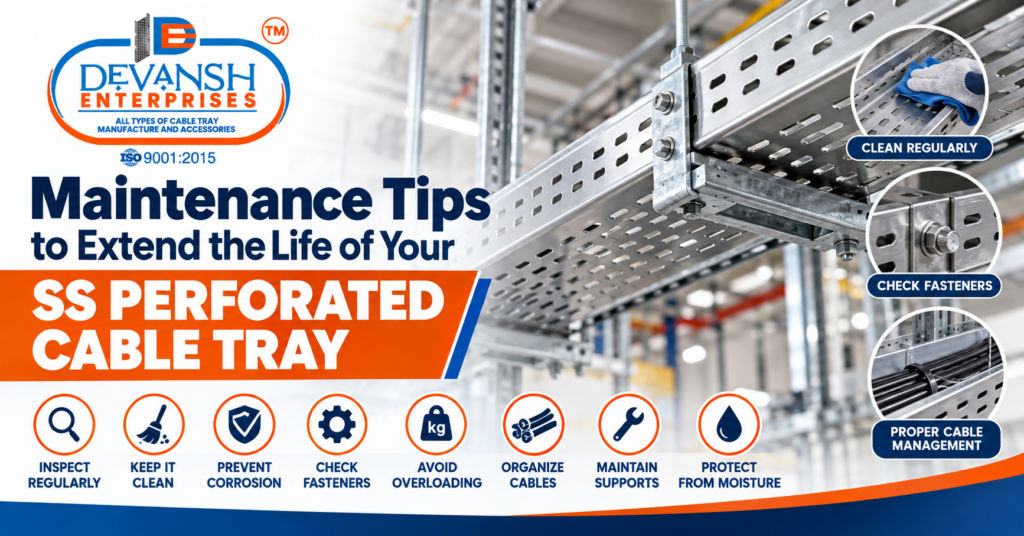
Electrical cable management is an essential part of every industrial facility, commercial building, data centre, manufacturing plant, and infrastructure project. A well-designed cable support system helps organize electrical wiring, improves accessibility, and supports safe and efficient operations. However, even high-quality stainless steel (SS) perforated cable trays require regular inspection and maintenance to deliver reliable long-term performance.
Regular maintenance can extend the service life of stainless steel perforated cable trays by preventing corrosion, removing contaminants, maintaining secure connections, and avoiding excessive loads. Regular inspections, suitable cleaning methods, and timely repairs help maintain safe and reliable cable management in industrial and commercial facilities.
How to Extend the Life of SS Perforated Cable Trays
To extend the lifespan of an SS perforated cable tray, perform regular inspections, remove dust and chemical deposits, use stainless steel-compatible cleaning products, check bolts and support brackets, and prevent excessive cable loading. Inspect for corrosion, mechanical damage, and moisture accumulation. Following the manufacturer’s installation and maintenance recommendations helps preserve structural integrity and supports reliable long-term cable management.
Key maintenance practices include:
- Inspecting cable trays for visible damage and corrosion
- Cleaning stainless steel surfaces using non-abrasive materials
- Checking joints, bolts, brackets, and support structures
- Preventing cable overloading and excessive bending
- Keeping cables properly arranged and secured
- Identifying moisture exposure and chemical contamination
- Replacing severely damaged components when necessary
A preventive maintenance approach helps industrial facilities reduce avoidable repairs and maintain organized electrical installations.
Stainless steel perforated cable trays are widely used because of their corrosion resistance, structural strength, ventilation, and ability to support different types of electrical cables. Their perforated design allows air to circulate around the cables and provides convenient access for inspection, installation, and maintenance. Despite these advantages, environmental exposure, dust accumulation, chemical contamination, excessive loading, loose fasteners, and improper installation can affect their service life.
The best way to extend the life of a stainless steel perforated cable tray is to combine routine cleaning, corrosion inspection, load management, fastener checks, and preventive maintenance. These practices can help reduce unexpected repairs, maintain cable support, and improve the reliability of the overall electrical installation.
In this guide, Devansh Enterprises explains practical maintenance tips for stainless steel perforated cable trays, including recommended inspection procedures, common problems, preventive measures, and best practices for industrial cable management.
What Is an SS Perforated Cable Tray?
An SS perforated cable tray is a cable support system manufactured from stainless steel sheets containing regularly spaced holes or perforations. These openings help reduce the tray’s weight, promote ventilation, and provide convenient options for securing and routing cables.
Stainless steel contains chromium, which helps form a thin, protective passive layer on its surface. This layer provides resistance to corrosion under suitable environmental conditions. Depending on the application, stainless steel grades such as SS 304 and SS 316 may be selected for their respective corrosion-resistance properties.
SS perforated cable trays are commonly used in:
- Manufacturing plants and industrial facilities
- Food processing and pharmaceutical units
- Commercial buildings and office complexes
- Data centres and IT infrastructure
- Water treatment and utility facilities
- Chemical processing environments, where the selected grade is suitable
- Electrical control rooms and equipment installations
Although stainless steel is durable, it is not completely immune to corrosion, contamination, mechanical damage, or wear. Regular maintenance is therefore important for preserving its performance.
Why Is Regular Cable Tray Maintenance Important?
Cable trays are often installed in ceilings, service corridors, industrial roofs, utility rooms, and other areas that are difficult to access. Because these systems may remain out of sight for long periods, small problems can go unnoticed until they affect cable routing or structural stability.
A consistent maintenance programme offers several benefits.
1. Helps Prevent Corrosion
Dust, moisture, chemical deposits, salt contamination, and contact with incompatible metals can affect stainless steel surfaces. Regular inspection and appropriate cleaning help identify early warning signs before damage becomes more serious.
2. Maintains Structural Strength
Cable trays must support the weight of installed cables within their rated capacity. Loose joints, damaged supports, excessive loading, or bent sections may compromise their ability to carry that load safely.
3. Improves Cable Safety
Sharp edges, damaged perforations, loose components, and poorly secured cables may increase the risk of cable abrasion or insulation damage. Maintenance helps identify and correct these issues.
4. Reduces Unexpected Repair Costs
Minor problems are generally easier to address than extensive corrosion, structural deformation, or cable damage. Preventive maintenance can help reduce downtime and avoid unnecessary replacement.
5. Supports Reliable Electrical Operations
Cable trays provide an organized route for electrical and communication cables. Maintaining their condition helps technicians inspect, trace, and service cable installations more efficiently.
12 Essential Maintenance Tips to Extend the Life of Your SS Perforated Cable Tray
The following practices can help maintain stainless steel cable trays in good working condition.
1. Conduct Regular Visual Inspections
Visual inspection is one of the simplest and most effective maintenance activities. It helps identify developing problems before they require major corrective work.
Inspect accessible tray sections, joints, brackets, supports, bends, and connection points. Look for signs of corrosion, deformation, cracks, loose fasteners, unusual movement, or damaged edges.
Pay particular attention to:
- Tray joints and splice connections
- Supports, brackets, and cantilever arms
- Areas exposed to moisture or chemicals
- Sections carrying heavy cable bundles
- Changes in direction and elevation
- Locations near pumps, motors, or vibrating equipment
- Outdoor sections exposed to rain and environmental contaminants
For critical installations, consider documenting inspection findings with photographs and a maintenance log.
Practical tip: Establish a baseline inspection when the installation is commissioned. Comparing later inspections against this baseline makes it easier to identify changes in condition.
2. Clean the Tray Surface Properly
Dust, industrial deposits, oil, and other contaminants can accumulate on cable trays over time. Cleaning helps preserve the surface condition and makes inspections more effective.
For routine cleaning, use a soft cloth, a non-abrasive brush, or a suitable cleaning solution recommended for the stainless steel grade and the surrounding environment.
Follow these basic steps:
- Arrange safe access to the installation.
- Follow the facility’s electrical safety and isolation procedures.
- Remove loose dust and debris using suitable equipment.
- Clean contaminated areas with an approved, non-abrasive cleaner.
- Rinse when required by the cleaning product instructions.
- Dry the surface where practical and inspect for remaining deposits.
Avoid steel wool, carbon-steel wire brushes, and abrasive pads that may introduce free iron particles or scratch the protective surface.
Do not use a cleaning chemical simply because it works on ordinary metal. Products containing unsuitable concentrations of chlorides or other aggressive chemicals may damage stainless steel under certain conditions.
Cleaning methods should also account for the cables installed inside the tray. Avoid directing liquids or cleaning agents onto electrical connections, cable terminations, or equipment that is not rated for such exposure.
3. Check for Early Signs of Corrosion
Stainless steel is known for its corrosion resistance, but its performance depends on the grade, surface condition, environment, and maintenance practices.
During inspections, look for:
- Brown or orange staining
- Small pits or cavities on the surface
- Localized corrosion around fasteners
- Deposits in joints and crevices
- Discolouration near chemical exposure points
- Corrosion around contact areas between different metals
Surface staining does not always indicate deep structural damage. However, persistent staining or visible pitting should be investigated rather than ignored.
If corrosion is present, determine its likely cause before cleaning or repairing the affected area. Depending on the condition, professional cleaning, suitable stainless steel treatment, or component replacement may be required.
Do not apply ordinary paint over corrosion as a substitute for proper assessment. Coatings can conceal developing damage without addressing its underlying cause.
Where corrosion is recurring, review the selected stainless steel grade, drainage conditions, cleaning chemicals, and surrounding environmental exposure.
4. Use the Correct Cleaning Chemicals
Chemical selection is especially important in pharmaceutical plants, food processing facilities, coastal locations, wastewater installations, and industrial environments.
Certain chemicals can attack stainless steel or interfere with its protective passive layer. Chloride-containing solutions are a particular concern because they can contribute to pitting and crevice corrosion under suitable conditions.
To reduce the risk:
- Use cleaners approved for the stainless steel grade.
- Follow the manufacturer’s dilution and contact-time instructions.
- Avoid unapproved acidic or chloride-rich products.
- Do not allow chemical residues to remain on the surface.
- Rinse and dry the tray where the cleaning procedure requires it.
- Consult a corrosion specialist when dealing with aggressive chemicals.
Never mix cleaning chemicals unless the product instructions specifically permit it. Mixing incompatible products can create hazardous reactions.
For facilities using multiple cleaning agents, maintain a written list of approved products and communicate it to maintenance personnel.
5. Inspect Bolts, Nuts, and Connection Points
Cable tray sections are commonly joined using splice plates, bolts, nuts, and other connection hardware. These components help maintain continuity and structural stability throughout the installation.
Over time, vibration, thermal movement, installation errors, or environmental exposure may affect connections.
During maintenance, check for:
- Missing bolts or nuts
- Loose splice plates
- Damaged threads
- Corroded fasteners
- Misaligned tray sections
- Unusual movement at joints
- Incorrect or incompatible replacement hardware
Use fasteners compatible with the tray material and operating environment. Mixing metals without evaluating their compatibility may create a risk of galvanic corrosion when moisture is present.
Tighten connections according to the relevant installation instructions and specified torque requirements. Excessive tightening can damage components, while insufficient tightening may allow unwanted movement.
Avoid tightening or replacing fasteners on a loaded tray without assessing the structural and electrical safety implications. Where required, arrange controlled access and temporary support before carrying out repairs.
6. Prevent Overloading the Cable Tray
Overloading is a major maintenance concern because excessive weight can cause sagging, deformation, or failure of tray sections and their supporting structures.
The safe load capacity depends on factors such as tray dimensions, material thickness, support spacing, span length, installation configuration, and the manufacturer’s rated load data.
To maintain safe loading:
- Compare the installed cable load with the approved design.
- Avoid adding cables without checking the remaining capacity.
- Follow the specified support spacing.
- Inspect for sagging between support points.
- Investigate bent sides, distorted perforations, or damaged brackets.
- Keep maintenance equipment and unrelated materials off the tray.
- Review loading whenever a cable installation is expanded.
Do not estimate the safe capacity solely from the tray’s appearance or material thickness. Obtain the applicable load ratings and installation specifications.
If deformation is observed, assess the cause before making repairs. Simply straightening a damaged section may not restore its original structural capacity.
7. Maintain Correct Cable Arrangement
Cable trays should provide organized support rather than become overcrowded storage spaces for electrical wiring.
Poor cable arrangement can make inspection difficult, increase the chance of abrasion, obstruct access, and interfere with heat dissipation. It may also complicate the identification and replacement of individual cables.
Good cable management practices include:
- Keeping cables neatly routed and appropriately secured
- Following the approved cable fill and loading requirements
- Maintaining specified separation between different cable types
- Avoiding tight bends beyond the cable manufacturer’s limits
- Preventing cables from rubbing against sharp edges
- Using suitable restraints that do not damage insulation
- Keeping cable identification labels readable
Do not add cable ties or restraints so tightly that they deform cable insulation. Similarly, avoid using sharp metal wire or unsuitable fastening materials that can cut into cable jackets.
Where electrical, instrumentation, communication, and other cable categories require separation, follow the project’s electrical design and applicable standards.
Organized cable routing makes preventive maintenance easier because technicians can inspect tray surfaces, identify cable routes, and detect abnormal conditions more efficiently.
8. Check the Tray Supports and Mounting Structure
A cable tray is only as reliable as the structure supporting it. Even a tray in good condition may become unsafe if its brackets, suspension rods, anchors, or mounting surfaces deteriorate.
Inspect the entire support system, including components that may be partly hidden behind equipment or above ceilings.
Check for loose anchors, bent brackets, damaged suspension hardware, corrosion, cracks in mounting surfaces, and unusual movement.
Outdoor installations should receive particular attention after severe weather or when there is evidence of water ingress. Installations near heavy machinery should also be inspected for vibration-related movement.
Maintenance personnel should verify that replacement supports match the approved design and are suitable for the expected loading and environment.
Never modify the support spacing or remove a bracket without assessing the effect on the complete cable tray system.
If a support is damaged, arrange appropriate temporary support before removing or replacing components when necessary. Structural repairs should follow the relevant engineering and safety procedures.
9. Protect the Tray from Moisture and Chemical Deposits
Moisture can contribute to corrosion, especially when combined with salt, chemicals, trapped dirt, or incompatible metal contact.
Although stainless steel performs well in many demanding environments, its resistance can decrease when contaminants remain trapped against the surface.
To reduce moisture-related risks:
- Check for water pooling around supports and joints.
- Keep drainage paths clear where the installation design provides them.
- Remove deposits that can retain moisture.
- Investigate recurring leaks from roofs, pipes, or nearby equipment.
- Inspect outdoor sections after prolonged rainfall.
- Ensure that the selected stainless steel grade is appropriate for the environment.
Cable trays should not be modified to create drainage openings unless the change is approved by the responsible designer or manufacturer. Unapproved modifications can affect structural performance or create sharp edges.
For installations exposed to marine air, aggressive chemicals, or frequent washdown, establish a maintenance schedule based on actual exposure conditions rather than relying on a generic cleaning interval.
10. Inspect for Sharp Edges and Mechanical Damage
Physical damage may occur during installation, cable pulling, nearby construction, equipment movement, or routine maintenance.
Damaged edges and distorted perforations can create abrasion points that threaten cable insulation. Bent sections may also affect alignment and the way loads are distributed.
Inspect for:
- Sharp burrs around perforations
- Damaged or deformed tray edges
- Bent sidewalls
- Cracked or distorted joints
- Impact damage
- Damaged protective surface finishes
- Protruding fasteners that could interfere with cables
If damage is found, assess whether the affected section can be repaired safely or should be replaced.
Do not leave a sharp edge exposed simply because the tray remains capable of carrying its load. Cable insulation damage can create serious electrical risks.
Any approved repair should preserve the required structural performance and corrosion resistance. After repair, inspect the area for burrs, contamination, and other defects before returning the installation to service.
11. Check Grounding and Electrical Bonding Requirements
Metallic cable trays may form part of an electrical bonding or grounding arrangement, depending on the installation design and applicable regulations.
A visually clean tray does not automatically guarantee electrical continuity. Loose joints, unsuitable coatings, corrosion, or incorrect installation may affect the intended bonding path.
Where the design requires tray bonding or grounding, maintenance should include verification of the relevant connections by qualified electrical personnel.
Important checks may include:
- Confirming that specified bonding conductors are present
- Inspecting bonding jumpers and their connections
- Checking for corrosion or damage at bonding points
- Verifying electrical continuity using an appropriate method
- Confirming that modifications have not interrupted the designed path
Do not assume that every tray joint provides the required electrical continuity. Follow the manufacturer’s instructions, approved electrical drawings, and applicable local standards.
Never use an improvised test or disconnect a grounding conductor while the system is in service. Electrical testing and corrective work must be performed by qualified personnel using appropriate safety procedures.
12. Maintain Accurate Inspection and Repair Records
Maintenance records help transform individual inspections into an effective preventive maintenance programme.
Record the inspection date, tray location, observed condition, corrective action, and any follow-up work required. Photographs can be particularly useful when monitoring recurring corrosion or mechanical deformation.
A practical maintenance register may include:
| Inspection item | What to check | Recommended action |
|---|---|---|
| Tray surface | Dust, deposits, staining | Clean using an approved method |
| Corrosion | Pitting, localized attack | Investigate the cause and assess damage |
| Fasteners | Loose, missing, or damaged hardware | Repair using approved compatible parts |
| Tray loading | Sagging or excessive cable weight | Verify load capacity and support arrangement |
| Supports | Bent brackets, loose anchors | Arrange an approved structural repair |
| Cable routing | Abrasion, overcrowding, poor restraint | Correct the arrangement safely |
| Electrical bonding | Damaged or loose connections | Arrange qualified electrical inspection |
| Mechanical condition | Sharp edges, cracks, deformation | Repair or replace as appropriate |
Keep records accessible to authorized maintenance personnel. They can help identify recurring problems, plan shutdown work, and determine when a tray section may need replacement.
SS 304 vs SS 316: Which Stainless Steel Grade Requires More Maintenance?
Selecting the appropriate stainless steel grade is an important factor in the long-term performance of perforated cable trays. SS 304 and SS 316 are commonly considered for industrial cable management applications, but their corrosion resistance differs.
| Feature | SS 304 | SS 316 |
|---|---|---|
| Corrosion resistance | Good in many general environments | Better resistance to chloride-related pitting |
| Typical applications | Indoor commercial and industrial facilities | Coastal and certain chemical-processing environments |
| Maintenance requirements | Depends on contamination and exposure | Depends on contamination and exposure |
| Chloride resistance | Lower than SS 316 | Generally higher than SS 304 |
| Relative material cost | Generally lower | Generally higherc |
Why Material Selection Matters
SS 304 is suitable for many indoor applications where environmental exposure is relatively controlled. However, environments containing significant chloride deposits, salt spray, or aggressive chemicals may require a more corrosion-resistant grade.
SS 316 contains molybdenum, which improves resistance to certain forms of localized corrosion compared with SS 304.
Nevertheless, neither grade is completely corrosion-proof. Both require appropriate cleaning, inspection, and maintenance.
For demanding environments, material selection should be based on operating temperature, chemical exposure, chloride concentration, installation conditions, and engineering recommendations.c
Common SS Perforated Cable Tray Problems and Their Solutions
Identifying common maintenance problems early helps prevent more extensive damage and reduces the risk of unexpected equipment interruptions.
| Common problem | Possible cause | Recommended solution |
|---|---|---|
| Surface rust staining | Iron contamination or environmental deposits | Identify the source and clean using an approved method |
| Cable tray sagging | Excessive loading or inadequate support | Verify loading and support design |
| Loose fasteners | Vibration or improper installation | Inspect and tighten according to specifications |
| Cable insulation abrasion | Sharp edges or improper cable routing | Correct the hazard and inspect affected cables |
| Water accumulation | Leakage or poor drainage | Eliminate the moisture source |
| Localized pitting | Chloride exposure or aggressive chemicals | Assess corrosion severity and material suitability |
| Tray misalignment | Mechanical impact or damaged supports | Repair or replace affected components |
| Difficult cable access | Overcrowding or poor cable arrangement | Review cable routing and available capacity |
Why Early Troubleshooting Is Important
Small maintenance issues can become more serious when ignored. For example, a loose support bracket may allow excessive movement, while persistent chemical deposits may contribute to localized corrosion.
Maintenance teams should document the issue, determine its cause, and select a corrective action that meets the installation’s engineering and safety requirements.
How Often Should an SS Perforated Cable Tray Be Inspected?
There is no single inspection interval that suits every installation. The appropriate frequency depends on the operating environment, cable load, accessibility, exposure to moisture or chemicals, equipment vibration, and the consequences of failure.
A practical starting point is to use a risk-based schedule and adjust it based on observed conditions and manufacturer recommendations.
Routine inspection
Carry out periodic visual checks for obvious damage, abnormal movement, contamination, and cable-routing problems. The interval should reflect the criticality of the installation and the surrounding conditions.
Detailed preventive maintenance
Schedule more thorough inspections to assess joints, fasteners, supports, corrosion, loading, and bonding requirements where applicable. Follow the facility’s approved maintenance programme.
Event-based inspection
Arrange additional checks after events such as:
- Severe weather affecting outdoor installations
- Chemical spills or accidental contamination
- Nearby construction or mechanical impact
- Major cable additions or removals
- Equipment vibration problems
- Water leaks or flooding
- Electrical faults or suspected cable damage
High-risk environments
Facilities exposed to aggressive chemicals, coastal salt, high humidity, frequent washdown, or significant vibration may need more frequent inspections than clean indoor environments.
The responsible maintenance engineer should determine the final inspection schedule using the manufacturer’s guidance, site risk assessment, and applicable standards.
Common Maintenance Mistakes to Avoid
Even well-intentioned maintenance can damage stainless steel or create safety issues when unsuitable methods are used.
Avoid the following mistakes:
Using carbon-steel brushes: These can transfer iron particles to stainless steel and contribute to surface rust staining.
Ignoring early corrosion: Small areas of pitting or persistent staining may indicate a developing environmental or material compatibility problem.
Using aggressive chemicals: Unsuitable cleaners can damage the passive layer or increase corrosion risk.
Overloading the tray: Additional cables must be assessed against the approved load capacity and support arrangement.
Replacing fasteners with incompatible materials: Incorrect hardware can compromise mechanical integrity or increase galvanic corrosion risk.
Ignoring damaged edges: Burrs and sharp metal surfaces may cut or abrade cable insulation.
Making unapproved modifications: Drilling holes, cutting sections, changing supports, or altering joints can affect structural strength and compliance.
Skipping electrical safety procedures: Maintenance must not expose personnel to energized equipment or compromise required grounding and bonding arrangements.
Cleaning without proper access planning: Work at height, around heavy cable bundles, or near energized equipment requires suitable controls.
SS Perforated Cable Tray Preventive Maintenance Schedule
A planned maintenance schedule helps facility managers monitor cable tray condition and identify potential problems before they affect operations.
The following is an illustrative schedule. Actual inspection intervals should be determined through a site-specific risk assessment, applicable standards, and manufacturer guidance.
| Maintenance activity | Illustrative interval |
|---|---|
| Visual inspection of accessible sections | Monthly |
| Dust and surface contamination check | Monthly |
| Detailed inspection of bolts and joints | Every 3–6 months |
| Corrosion and moisture assessment | Every 3–6 months |
| Cable loading and support inspection | Every 6 months |
| Review of cable arrangement | Every 6 months |
| Detailed structural inspection | Annually |
| Review of maintenance records | Annually |
Important Maintenance Considerations
High-humidity environments, chemical processing plants, coastal facilities, and installations exposed to vibration may require more frequent checks.
Maintenance teams should also conduct additional inspections after equipment modifications, accidental impacts, water leakage, or significant cable additions.
Regular documentation helps establish maintenance trends and supports better long-term planning.
Environmental Factors That Affect Stainless Steel Cable Tray Lifespanc
The operating environment plays an important role in determining how long a stainless steel perforated cable tray can remain in service.
Humidity and Moisture
Persistent moisture can increase the risk of corrosion, particularly where contaminants accumulate around joints and fasteners.
Coastal Air and Salt Exposure
Airborne salt deposits can contribute to localized corrosion. Facilities near coastal areas should pay particular attention to cleaning frequency and material selection.
Industrial Chemicals
Chemical vapours, cleaning agents, and process residues may affect stainless steel surfaces. Chemical compatibility should be evaluated before installation and during maintenance.
Temperature Changes
Temperature fluctuations can cause thermal expansion and contraction. Installations should accommodate expected movement according to the approved design.
Mechanical Vibration
Equipment such as motors, pumps, compressors, and industrial machinery may transmit vibration to nearby cable support systems. Periodic inspection helps identify loose connections or movement.
Dust and Airborne Contaminants
Industrial dust can collect on cable tray surfaces and around cable bundles. Certain deposits can retain moisture or make corrosion harder to detect.
Understanding these environmental factors allows maintenance engineers to develop inspection programmes appropriate for the actual operating conditions.
How Preventive Maintenance Helps Reduce Long-Term Cable Management Costs
Preventive maintenance is not simply about keeping cable trays clean. It also supports more predictable facility maintenance expenses and reduces the likelihood of unexpected repairs.
Regular inspection helps identify problems such as loose brackets, corrosion, overloaded sections, and damaged connections before they become more difficult to address.
Key Cost Benefits
Reduced component replacement: Identifying surface contamination and localized damage early may prevent avoidable deterioration.
Lower risk of unexpected downtime: Planned inspections make it easier to schedule corrective work during approved maintenance windows.
Better use of existing infrastructure: Maintaining the condition of installed cable trays can help facilities obtain longer useful service from suitable components.
Improved maintenance planning: Inspection records allow maintenance teams to prioritize repairs and allocate resources more effectively.
Reduced risk of secondary cable damage: Identifying sharp edges, damaged supports, and excessive movement may help protect installed cable systems.
The actual financial benefits depend on installation size, environmental exposure, maintenance costs, and the consequences of equipment downtime.
Facilities should compare preventive maintenance costs against historical repair and replacement expenses to evaluate the effectiveness of their maintenance programme.c
Best Practices for Different Installation Environments
Maintenance requirements vary considerably depending on where the tray is installed.
Indoor industrial facilities
Focus on dust, oil deposits, vibration, cable loading, and mechanical impact. Cleaning frequency should reflect the production environment and the types of contaminants present.
Outdoor installations
Inspect for rainwater exposure, airborne contaminants, salt deposits, weather-related damage, and changes in support condition. Check the suitability of the stainless steel grade for the local environment.
Food and pharmaceutical facilities
Use cleaning products and methods approved for the application. Avoid leaving chemical residues, and coordinate maintenance with hygiene requirements and the site’s operating procedures.
Coastal and marine environments
Pay particular attention to salt deposits, crevices, dissimilar-metal contact, and localized corrosion. The material grade and cleaning programme should be selected for the specific exposure conditions.
Chemical processing facilities
Identify the chemicals present and verify compatibility with the stainless steel grade, fasteners, and cleaning products. Consult a corrosion specialist when the environment is particularly aggressive or corrosion recurs.
Data centres and electrical rooms
Prioritize cable organization, load management, unobstructed access, identification labels, and the condition of joints and supports. Maintenance work must also respect operational continuity and electrical safety requirements.
When Should an SS Perforated Cable Tray Be Repaired or Replaced?
Cleaning and routine tightening are not sufficient when a tray has suffered significant structural or corrosion damage.
Repair or replacement may be necessary when inspection identifies:
- Deep or widespread corrosion
- Cracked or severely deformed sections
- Significant sagging or loss of structural capacity
- Damaged joints that cannot be restored reliably
- Supports that cannot safely carry the intended load
- Sharp edges that cannot be corrected through an approved repair
- Damage affecting required electrical bonding arrangements
- Repeated failures caused by unsuitable materials or environmental exposure
Before replacing a damaged section, investigate the cause of failure. Otherwise, the same problem may affect the new component.
A replacement should match the required dimensions, material grade, loading capacity, connection system, and environmental suitability. Installation should follow the approved design and the manufacturer’s instructions.
Safety Precautions Before Maintaining SS Perforated Cable Trays
Cable tray maintenance often takes place near electrical cables, industrial equipment, elevated structures, and restricted-access areas. Appropriate safety procedures are essential.
Before starting maintenance work:
- Conduct a site-specific risk assessment.
- Identify nearby energized electrical equipment.
- Follow applicable isolation and lockout/tagout procedures.
- Use appropriate personal protective equipment.
- Arrange safe access when working at height.
- Avoid standing on or using cable trays as work platforms.
- Use tools and cleaning products suitable for the installation.
- Do not disturb cable terminations or grounding connections without authorization.
- Ensure that any required temporary support is installed before removing structural components.
- Verify that the installation is safe before returning it to normal service.
Electrical testing, bonding modifications, structural repairs, and work near energized conductors should be performed by appropriately qualified personnel.
Safety procedures should always take priority over maintenance speed or convenience.
How to Create an Effective Preventive Maintenance Plan
A preventive maintenance plan makes cable tray maintenance more consistent and easier to manage.
Step 1: Maintain an installation inventory. Record tray routes, material grades, dimensions, support locations, environmental exposure, and critical sections.
Step 2: Identify high-risk areas. Prioritize locations exposed to chemicals, moisture, vibration, high cable loads, or difficult access.
Step 3: Establish inspection criteria. Define what constitutes acceptable condition, what requires corrective action, and which findings require immediate escalation.
Step 4: Assign responsibilities. Make sure inspections and electrical testing are performed by personnel with appropriate training and authorization.
Step 5: Use approved cleaning procedures. Document compatible cleaners, tools, protective equipment, and methods for removing contaminants.
Step 6: Track defects until closure. Record problems, assign corrective actions, and verify that repairs have been completed satisfactorily.
Step 7: Review maintenance results. If the same problem keeps returning, reassess the material selection, installation design, loading, or surrounding environment.
A preventive approach is generally more effective than waiting for visible damage to become a major operational issue.
Frequently Asked Questions (FAQs)
1. How can I extend the life of an SS perforated cable tray?
Inspect the tray regularly, clean it using compatible products, prevent overloading, check fasteners and supports, control chemical exposure, and address corrosion or mechanical damage promptly. The inspection schedule should reflect the operating environment and manufacturer recommendations.
2. Does stainless steel cable tray require maintenance?
Yes. Stainless steel offers corrosion resistance, but it still requires appropriate cleaning and inspection. Dust, salt, chemicals, poor drainage, mechanical damage, and incompatible metal contact can affect its condition over time.
3. Which cleaning products are suitable for stainless steel cable trays?
Use a cleaner approved for the stainless steel grade and the installation environment. Avoid abrasive tools and unsuitable chloride-containing products. Follow the cleaner’s instructions, including rinsing and drying requirements.
4. What causes rust stains on stainless steel cable trays?
Possible causes include iron-particle contamination, surface deposits, unsuitable chemical exposure, localized corrosion, and contact with incompatible materials. The cause should be identified before choosing a cleaning or repair method.
5. Can stainless steel cable trays be installed outdoors?
Yes, provided the tray grade, thickness, support arrangement, fasteners, and installation design are suitable for the environmental conditions. Outdoor exposure, especially near coastal areas or aggressive chemicals, should be considered during material selection.
6. How do I know if a cable tray is overloaded?
Warning signs may include excessive sagging, bent sidewalls, distorted joints, damaged supports, or unusual movement. These signs require investigation, but a tray can also be overloaded without obvious deformation. Always check the approved load ratings and design requirements.
7. Can I use a carbon-steel wire brush to clean stainless steel?
It is generally best to avoid carbon-steel brushes because they can introduce iron contamination. Use a suitable non-abrasive cleaning tool approved for stainless steel.
8. Should cable tray fasteners be replaced with stainless steel bolts?
Replacement hardware must be compatible with the tray material, environmental conditions, structural requirements, and manufacturer’s specifications. Stainless steel fasteners may be appropriate in many applications, but compatibility and galvanic corrosion risks should be evaluated.
9. Why are cable tray support brackets important?
Brackets, anchors, and suspension systems transfer the cable load to the building or supporting structure. Damaged or incorrectly spaced supports can compromise the entire installation, even when the tray itself appears undamaged.
10. When should a damaged cable tray be replaced?
Replacement should be considered when corrosion, cracking, deformation, damaged joints, or support failures compromise safe performance and cannot be corrected through an approved repair. A qualified person should assess the damage and verify the required replacement specifications.
11. Does perforation affect the maintenance of a cable tray?
Yes. Perforations can improve ventilation and provide convenient cable access, but dust and contaminants may collect around openings and edges. These areas should be inspected for deposits, corrosion, sharp burrs, and mechanical damage.
12. Who should maintain stainless steel cable tray installations?
Routine visual inspections may be performed by trained maintenance personnel following site procedures. Structural repairs, electrical bonding checks, and work involving energized equipment should be handled by appropriately qualified personnel.
Cable Management Solutions from Devansh Enterprises
Choosing suitable cable management components is an important step toward building reliable electrical infrastructure.
Devansh Enterprises manufactures cable trays and accessories for industrial and commercial applications. The company provides cable management solutions intended to support organized cable routing across a range of installation requirements.
When selecting stainless steel perforated cable trays, buyers and project engineers should consider:
- Stainless steel material grade
- Tray width, depth, and thickness
- Expected cable loading
- Required support spacing
- Installation environment
- Corrosion exposure
- Compatibility of joints and accessories
- Maintenance accessibility
Selecting suitable products and following the approved installation design can help support long-term performance.
For more information about cable management products and industrial requirements, visit Devansh Enterprises.
Website: https://devanshenterpriseindia.com/
Conclusion
Stainless steel perforated cable trays are a durable and practical choice for organizing electrical cables in industrial and commercial installations. However, their long-term performance depends on more than material quality alone. Regular inspection, proper cleaning, corrosion prevention, load management, secure supports, compatible fasteners, and safe electrical maintenance all play important roles in extending service life.
The most effective maintenance strategy is preventive rather than reactive. By identifying early warning signs, documenting inspection results, and correcting the underlying causes of damage, facility managers can help reduce unexpected downtime, protect cable installations, and make better use of their infrastructure investment.
Devansh Enterprises provides cable tray manufacturing solutions and accessories for industrial and commercial cable management requirements. When planning a new installation or replacing damaged components, consider the required material grade, operating environment, load capacity, and applicable installation standards to support dependable long-term performance.
For product information and cable management requirements, visit the Devansh Enterprises website: https://devanshenterpriseindia.com/
Maintenance note: Always follow the cable tray manufacturer’s instructions, the approved engineering design, applicable electrical and safety standards, and site-specific maintenance procedures.
What is the expected lifespan of a stainless steel perforated cable tray?
There is no universal lifespan for stainless steel perforated cable trays. Service life depends on material grade, environmental exposure, loading, installation quality, and maintenance practices. A correctly selected and maintained system may remain functional for many years, but its condition should be assessed through regular inspections.
Is SS 316 better than SS 304 for outdoor cable trays?
SS 316 generally offers better resistance to chloride-related pitting than SS 304, making it a suitable option for consideration in certain coastal or chemically exposed environments. However, the final material selection should reflect the actual exposure conditions and engineering requirements.
Can stainless steel cable trays corrode?
Yes. Stainless steel can experience pitting, crevice corrosion, staining, and other forms of corrosion under unsuitable conditions. Appropriate grade selection, cleaning, and environmental controls help reduce these risks.
Does regular cleaning improve cable tray durability?
Regular cleaning helps remove deposits that may retain moisture or introduce corrosive contaminants. When performed with compatible cleaning products and methods, it can help preserve stainless steel surfaces and make early damage easier to identify.
What should maintenance engineers check first?
Begin by checking for visible deformation, corrosion, damaged supports, loose connections, and signs of cable abrasion. Any potentially unsafe condition should be escalated before further work is performed.
Protect Your Cable Management Investment with Preventive Maintenance
Stainless steel perforated cable trays provide durable and practical support for electrical cable installations across industrial and commercial facilities. However, their long-term performance depends on correct material selection, installation quality, environmental conditions, and consistent maintenance.
Routine inspections, appropriate cleaning, corrosion monitoring, secure fasteners, and proper cable loading all contribute to a more reliable cable management system.
Facility managers and maintenance engineers should focus on identifying problems early, documenting inspection findings, and addressing the causes of damage rather than relying only on temporary repairs.
Looking for reliable industrial cable management solutions?
Devansh Enterprises provides cable trays and accessories for different industrial and commercial requirements.
Explore the product range and connect with the team to discuss your project specifications.
