





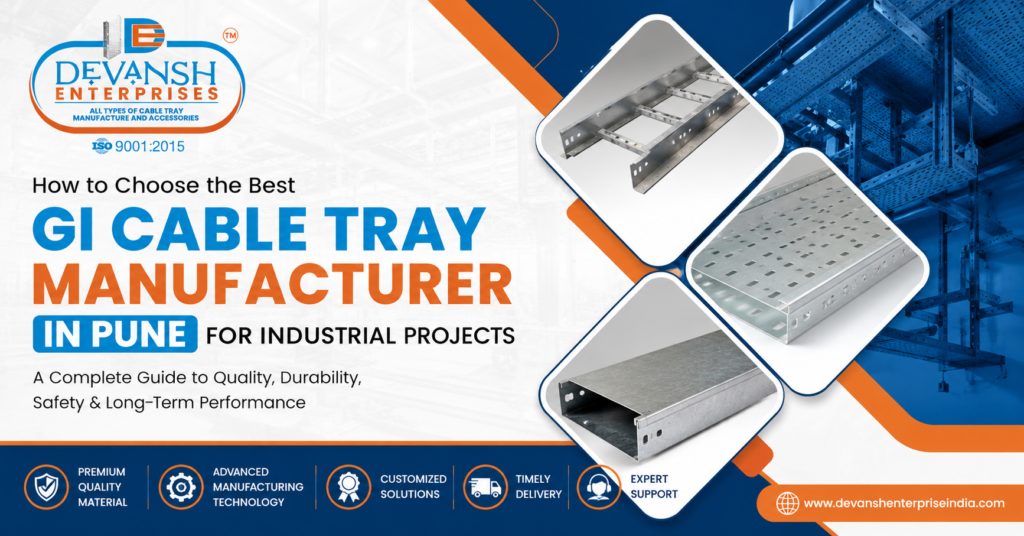
Industrial electrical systems depend on safe, durable, and well-engineered cable management solutions. Whether you are developing a manufacturing plant, commercial building, warehouse, pharmaceutical facility, data center, or power distribution network, selecting the right cable tray manufacturer directly impacts safety, maintenance costs, and long-term operational efficiency.
Choosing the right GI Cable Tray Manufacturer In Pune is not simply about comparing prices. It requires evaluating product quality, manufacturing standards, engineering capabilities, corrosion resistance, customization options, delivery timelines, after-sales support, and compliance with industry regulations.
Pune has become one of India’s leading manufacturing hubs, supplying cable management products to industries across Maharashtra and the country. With numerous manufacturers available, buyers often struggle to identify the most reliable supplier for their projects.
This comprehensive guide explains every important factor that should be considered before selecting a manufacturer, ensuring your industrial project receives cable management systems that deliver long-term performance and safety.
What is a GI Cable Tray?
A GI (Galvanized Iron) cable tray is a structural system designed to support, organize, and protect electrical cables throughout industrial and commercial buildings.
Unlike traditional conduit systems, cable trays provide:
- Easy cable routing
- Better ventilation
- Faster installation
- Simplified maintenance
- Future cable expansion
- Reduced installation costs
These systems are widely used for:
- Manufacturing plants
- Industrial automation
- Commercial buildings
- Hospitals
- IT parks
- Warehouses
- Data centers
- Solar power plants
- Oil & gas facilities
- Pharmaceutical units
- Infrastructure projects
Why Choosing the Right Manufacturer Matters
Cable trays are expected to perform for decades.
Poor-quality products may result in:
- Rust formation
- Structural deformation
- Cable sagging
- Unsafe electrical routing
- Frequent maintenance
- Increased operational costs
- Fire hazards due to improper cable support
A reputed manufacturer ensures every tray is engineered for durability, strength, and long service life.
Understand Your Project Requirements First
Before approaching any manufacturer, clearly identify your project needs.
Consider:
- Type of industry
- Indoor or outdoor installation
- Cable load
- Cable size
- Environmental conditions
- Corrosion exposure
- Required tray width
- Tray depth
- Span length
- Required accessories
Having complete project specifications helps manufacturers recommend the most suitable cable management system.
Types of GI Cable Trays Available
Different industrial applications require different cable tray designs.
Perforated Cable Trays
Suitable for:
- Electrical wiring
- Control cables
- Commercial buildings
- Industrial plants
Advantages:
- Excellent ventilation
- Lightweight
- Easy cable installation
- Reduced cable heating
Ladder Cable Trays
Ideal for:
- Heavy-duty power cables
- Large industrial installations
- Outdoor projects
Benefits:
- Maximum ventilation
- High load capacity
- Easy inspection
- Better heat dissipation
Raceway Systems
Perfect for:
- Commercial offices
- Data communication
- Indoor electrical routing
Benefits include:
- Complete cable protection
- Clean appearance
- Easy maintenance
Wire Mesh Cable Trays
Used in:
- Data centers
- IT infrastructure
- Communication systems
Advantages:
- Flexible routing
- Quick installation
- Lightweight construction
Check Manufacturing Experience
Experience plays a major role in manufacturing quality.
An established manufacturer generally offers:
- Better engineering
- Advanced production methods
- Proven quality control
- Faster customization
- Reliable customer support
Manufacturers with years of experience better understand industrial requirements and can recommend suitable solutions for complex projects.
Evaluate Material Quality
The strength of a cable tray depends heavily on raw material quality.
Look for manufacturers using premium-grade:
- Galvanized Iron
- Mild Steel
- Stainless Steel
- Hot Dip Galvanized Steel
- Aluminium
High-quality galvanized steel offers:
- Excellent corrosion resistance
- Longer lifespan
- Better structural integrity
- Improved weather resistance
Never compromise on material quality solely for lower pricing.
Verify Manufacturing Standards
Quality manufacturers follow recognized engineering standards and maintain consistent production processes. Many also emphasize in-house fabrication, quality control, and industrial-grade manufacturing practices for cable management systems.
Ask whether products comply with relevant industry specifications and whether quality checks are performed before dispatch.
Assess Manufacturing Infrastructure
Modern manufacturing facilities produce more accurate and consistent products.
Look for manufacturers having:
- CNC punching machines
- Precision bending machines
- Hydraulic presses
- Welding systems
- Powder coating facilities
- Galvanizing facilities
- Quality inspection equipment
Advanced machinery ensures dimensional accuracy and consistent quality.
Check Load Bearing Capacity
Industrial cable trays carry significant cable loads.
Always verify:
- Maximum load capacity
- Safe working load
- Span recommendations
- Deflection limits
Manufacturers should provide engineering guidance based on your cable weight and installation conditions.
Corrosion Resistance is Essential
Industrial environments often expose cable trays to:
- Moisture
- Chemicals
- Dust
- Heat
- Outdoor weather
- Coastal conditions
Proper galvanization significantly improves corrosion resistance and increases product lifespan.
Availability of Customized Solutions
Every industrial project is different.
Choose manufacturers capable of producing:
- Custom widths
- Custom heights
- Special bends
- Reducers
- Junctions
- Tees
- Crosses
- Vertical risers
- Horizontal elbows
Customization reduces installation challenges and minimizes site modifications.
Range of Accessories
A complete cable management system includes accessories.
Look for suppliers offering:
- Coupler plates
- Covers
- Clamps
- Supports
- Hangers
- Brackets
- Fasteners
- Reducers
- Expansion joints
Buying everything from one supplier ensures compatibility.
Timely Delivery
Industrial projects follow strict timelines.
Late material deliveries can delay:
- Electrical installation
- Equipment commissioning
- Civil work
- Project handover
Discuss:
- Production capacity
- Delivery schedules
- Emergency orders
- Inventory availability
Reliable manufacturers prioritize on-time delivery.
Engineering Support
Professional manufacturers assist customers by providing:
- Product recommendations
- Design suggestions
- Technical consultation
- Quantity estimation
- Installation guidance
Strong engineering support minimizes costly project errors.
Compare Product Pricing Wisely
Never select a supplier solely based on the lowest quotation.
Instead compare:
- Material thickness
- Galvanization quality
- Manufacturing standards
- Accessories included
- Warranty
- Delivery costs
- Product lifespan
Higher-quality products often reduce lifetime ownership costs.
Check Previous Industrial Projects
Experienced manufacturers typically serve industries such as:
- Manufacturing
- Pharmaceuticals
- Automotive
- Power generation
- Food processing
- Commercial infrastructure
- Warehousing
- Data centers
A diverse project portfolio demonstrates the ability to meet different application requirements.
Review Product Portfolio
A manufacturer offering multiple cable management products usually possesses stronger engineering capabilities.
Common products include:
- Perforated cable trays
- Ladder cable trays
- Wire mesh trays
- Raceway systems
- Cable tray accessories
- Junction boxes
- Support systems
A broad portfolio simplifies procurement for large projects.
Importance of Proper Finishing
Quality finishing improves:
- Corrosion resistance
- Appearance
- Durability
- Product lifespan
Inspect products for:
- Smooth edges
- Uniform galvanization
- Accurate dimensions
- Burr-free surfaces
- Strong weld quality
Look for In-House Manufacturing
Manufacturers with in-house production generally provide:
- Better quality control
- Faster customization
- Competitive pricing
- Reliable delivery
- Consistent product standards
Avoid suppliers who simply outsource manufacturing without adequate quality oversight.
Evaluate Customer Support
Professional customer service includes:
- Fast quotations
- Technical guidance
- Prompt communication
- After-sales support
- Installation assistance
Good customer service becomes especially valuable during large industrial projects.
Ask About Bulk Order Capability
Large industrial projects require uninterrupted supply.
Confirm:
- Monthly production capacity
- Stock availability
- Manufacturing lead time
- Logistics support
Manufacturers capable of handling bulk orders help prevent project delays.
Sustainability and Modern Manufacturing
Many industries now prioritize environmentally responsible manufacturing.
Choose manufacturers who emphasize:
- Efficient production
- Material optimization
- Reduced wastage
- Durable products with long service life
Sustainable manufacturing contributes to lower lifecycle costs.
Importance of Quality Inspection
Every cable tray should undergo inspection before dispatch.
Typical quality checks include:
- Dimensional accuracy
- Load capability
- Surface finish
- Material thickness
- Welding quality
- Coating consistency
Consistent inspections reduce installation issues.
Questions to Ask Before Finalizing a Manufacturer
Before placing your order, ask:
- What materials are used?
- Can custom sizes be manufactured?
- What industries do you serve?
- What is the delivery timeline?
- Are accessories available?
- What quality checks are performed?
- Can you support bulk orders?
- Do you provide technical assistance?
- What corrosion protection options are available?
- Can you manufacture according to project drawings?
Common Mistakes to Avoid
Many buyers make avoidable mistakes such as:
- Choosing only by price
- Ignoring material quality
- Not checking manufacturing capability
- Overlooking delivery schedules
- Buying incompatible accessories
- Ignoring corrosion requirements
- Skipping technical consultation
- Selecting suppliers without industrial experience
Avoiding these mistakes improves project reliability and reduces future maintenance costs.
Benefits of Choosing a Reliable Cable Tray Manufacturer
Working with a trusted manufacturer offers several advantages:
- Superior product quality
- Longer service life
- Improved electrical safety
- Reduced maintenance
- Better cable organization
- Faster installation
- Cost-effective long-term performance
- Technical expertise
- Custom fabrication
- Timely project completion
Industries That Require High-Quality GI Cable Trays
Reliable cable management systems are widely used in:
- Manufacturing plants
- Automobile industries
- Pharmaceutical companies
- Chemical processing units
- Data centers
- Warehouses
- Airports
- Metro rail projects
- Hospitals
- Educational institutions
- Commercial complexes
- Smart city infrastructure
- Renewable energy projects
- Food processing facilities
- Cement plants
Why Devansh Enterprises is a Trusted Choice
When selecting a cable tray supplier, businesses often prefer manufacturers that combine engineering expertise with dependable production capabilities. Devansh Enterprises manufactures a wide range of cable management products—including perforated cable trays, ladder cable trays, raceway systems, wire mesh trays, and related accessories—using materials such as GI, MS, SS, and aluminum. The company also highlights in-house design and fabrication, custom manufacturing options, timely delivery, and solutions for industrial, commercial, and infrastructure applications.
Final Thoughts
Selecting the right cable tray manufacturer is an investment in the safety, efficiency, and longevity of your electrical infrastructure. Rather than focusing only on price, evaluate engineering expertise, manufacturing quality, product range, customization capabilities, technical support, delivery performance, and long-term reliability.
A dependable manufacturer can help reduce installation challenges, improve cable management, minimize maintenance costs, and support uninterrupted industrial operations. By carefully assessing these factors, project owners, consultants, and contractors can ensure they choose a cable tray solution that delivers lasting value and dependable performance for years to come.
For organizations seeking durable cable management systems backed by quality manufacturing and technical expertise, Devansh Enterprises offers a comprehensive range of solutions designed to meet the demands of modern industrial and infrastructure projects.
GI cable trays are used to support, organize, and protect electrical cables in industrial, commercial, and infrastructure projects while allowing easy maintenance and ventilation.
Galvanized cable trays provide excellent corrosion resistance, longer service life, higher strength, and lower maintenance compared to untreated steel trays.
They are widely used in manufacturing plants, pharmaceutical facilities, commercial buildings, warehouses, power plants, IT parks, hospitals, and data centers.
You should evaluate material quality, manufacturing standards, customization options, production capacity, delivery timelines, technical support, and product range.
Common types include perforated cable trays, ladder cable trays, raceway systems, wire mesh cable trays, and channel cable trays.
Yes. Most leading manufacturers offer customized widths, heights, bends, reducers, tees, crosses, and accessories according to project requirements.
Check its load-bearing capacity, material thickness, galvanization quality, span recommendations, and engineering specifications provided by the manufacturer.
Corrosion-resistant cable trays last longer, require less maintenance, and protect electrical installations from environmental damage.
How to Choose the Best GI Cable Tray Manufacturer for Industrial Projects
- Define Your Project Requirements
Identify your project specifications, including cable load, installation environment, tray dimensions, and application type. This helps narrow down manufacturers that can meet your technical requirements.
- Check the Manufacturer’s Experience
Look for a manufacturer with extensive experience in producing cable management systems for industrial, commercial, and infrastructure projects. Experienced manufacturers are more likely to provide reliable products and technical guidance.
- Evaluate Product Quality
Ensure the manufacturer uses high-quality galvanized iron and follows strict quality control processes. Inspect the finish, thickness, strength, and corrosion resistance of the cable trays.
- Verify Manufacturing Standards
Choose a manufacturer that follows recognized manufacturing standards and industry best practices. Consistent production processes ensure product durability and safety.
- Review the Product Range
Select a supplier offering a comprehensive range of products such as perforated cable trays, ladder cable trays, raceway systems, wire mesh trays, and compatible accessories.
- Check Customization Capabilities
Industrial projects often require custom sizes and fittings. Confirm that the manufacturer can provide customized cable trays, bends, reducers, tees, crosses, and support systems based on your project drawings.
- Assess Load-Bearing Capacity
Verify that the cable trays are engineered to support your cable loads safely. Request technical specifications, span recommendations, and load capacity details before purchasing.
- Compare Pricing and Delivery
Evaluate quotations based on material quality, manufacturing standards, included accessories, warranty, and delivery timelines rather than choosing solely on price.
- Evaluate Customer Support
Choose a manufacturer that provides technical consultation, installation guidance, prompt communication, and reliable after-sales support throughout your project.
- Make an Informed Decision
Compare all shortlisted manufacturers based on quality, experience, customization, delivery performance, pricing, and customer service. Select the supplier that offers the best long-term value for your industrial project.