






When planning an electrical installation, selecting the right cable tray is only one part of the job. A complete and reliable cable management system also depends on the right fittings, supports, joining components, bends, branches, clamps, brackets and other accessories.
This is particularly important for industrial plants, manufacturing units, warehouses, commercial buildings, data centres, infrastructure projects and other facilities where large numbers of electrical, control, instrumentation and communication cables must be routed safely and systematically.
If you are searching for cable tray fittings for safe cable management systems Pune, it is important to look beyond the tray itself. The accessories determine how different sections connect, how cable routes change direction, how branches are created, how the system is supported and how easily the installation can be maintained or expanded in the future.
At Devansh Enterprise, we manufacture and supply cable trays and cable management solutions for industrial and commercial applications. Our product range includes perforated cable trays, ladder cable trays, wire mesh basket cable trays, raceways, trunking, rooftop walkways, mounting clamps and related accessories.
The objective is simple: provide customers with practical cable management solutions that are reliable, organized, durable and suitable for their project requirements.
In this detailed guide, we will explain the most important cable tray accessories, why they matter, how to select them and how a properly planned accessory system can improve the safety, appearance, installation efficiency and long-term maintainability of your electrical infrastructure.
Cable tray accessories are the fittings and supporting components used to connect, redirect, branch, reduce, support and protect cable tray systems. Common accessories include bends, tees, crosses, reducers, couplers, brackets, clamps, supports and covers. Selecting compatible accessories based on tray type, dimensions, cable load and installation environment helps create a safer and more organized cable management system.
What Are Cable Tray Accessories?
Cable tray accessories are the components used with cable trays to create a complete cable routing and support system.
A straight cable tray section can carry cables from one point to another, but real-world installations are rarely completely straight.
Cable routes may need to:
- Change direction
- Rise vertically
- Drop vertically
- Branch into multiple routes
- Join different tray sections
- Change width
- Connect to equipment
- Pass around structural obstacles
- Be supported from walls or ceilings
- Be suspended from structural members
- Provide additional cable segregation
- Allow future expansion
- Maintain electrical continuity where required
This is where accessories become essential.
Common cable tray accessories include:
- Couplers
- Tray joiners
- Horizontal bends
- Vertical bends
- Tees
- Crosses
- Reducers
- Right and left reducers
- Mounting brackets
- Wall-mounted brackets
- Clamps
- Support structures
- Fasteners
- Earthing accessories
- Covers
- Dividers
- Threaded rods
- Channels and support members
The exact accessory requirement depends on the cable tray type, route design, installation environment and project specifications.
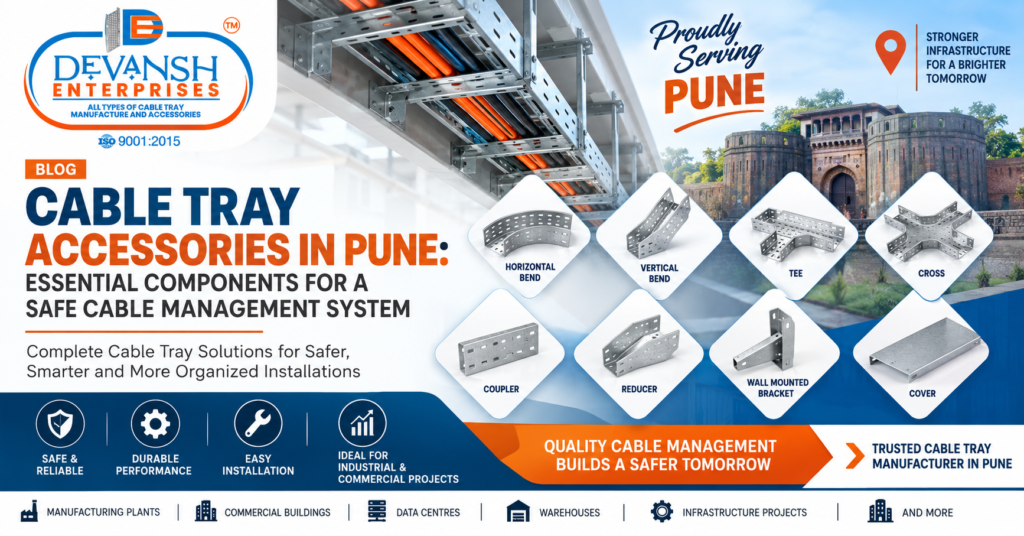
Devansh Enterprise’s existing product portfolio includes accessories such as tees, horizontal bends, vertical bends, reducers, couplers and wall-mounted brackets for relevant cable tray systems.
Why Cable Tray Accessories Are So Important
It is easy to think of accessories as small components that are added after selecting the main cable tray.
In reality, accessories should be considered during the initial cable routing design.
A cable tray system is only as effective as its weakest connection, support point or transition.
Imagine a factory where hundreds of cables travel through a building.
The main cable route may look straightforward on a drawing. However, once installation begins, the route may encounter:
- Columns
- Beams
- Walls
- Electrical panels
- Machines
- HVAC equipment
- Fire protection systems
- Pipework
- Doors
- Structural changes
- Different floor levels
Without the appropriate fittings, installers may have to improvise at the site.
Improvisation can lead to unnecessary cutting, drilling, bending or modification of trays.
A properly designed accessory system avoids many of these problems.
1. Accessories create continuous cable routes
Cable routes frequently change direction.
Horizontal bends allow the tray to turn without creating an unnecessarily sharp route.
Vertical bends allow the tray to move between different elevations.
Tees allow a primary cable route to branch into another direction.
Crosses allow multiple routes to intersect.
Together, these components allow engineers and installers to create a structured cable pathway.
2. Accessories improve installation efficiency
When compatible fittings are available, installation becomes more predictable.
Instead of fabricating every transition at the project site, installers can use purpose-designed components.
This can help reduce:
- Installation time
- Site modification
- Material wastage
- Rework
- Measurement errors
- Unplanned fabrication
3. Accessories support a professional installation
A well-designed cable management system looks organized.
This matters particularly in:
- Commercial buildings
- Data centres
- Industrial facilities
- Electrical rooms
- Manufacturing plants
- Warehouses
- Infrastructure projects
A neat cable route makes inspection and maintenance easier.
4. Accessories can support future expansion
Electrical installations often change over time.
A manufacturing plant may add machinery.
An office may expand.
A data centre may add network equipment.
A warehouse may install additional automation systems.
If the original cable route has been designed with appropriate capacity and accessible fittings, future modifications can be easier.
Main Types of Cable Tray Accessories
Different projects require different accessories.
Let’s examine the most important ones.
1. Cable Tray Couplers
A coupler, also called a tray joiner or joining component, connects two cable tray sections.
Straight tray lengths are manufactured in individual sections. When several sections are installed together, they need to be joined securely.
This is the primary function of the coupler.
Why are couplers important?
A cable tray route may extend for tens or even hundreds of metres.
The tray sections must work together as a continuous system.
A suitable coupler helps create:
- Secure connections
- Better alignment
- Consistent installation
- Easier assembly
- Reliable tray continuity
The correct coupler should be compatible with the specific tray profile, dimensions and material.
What should you check before purchasing couplers?
Consider:
- Tray width
- Tray side height
- Tray thickness
- Material
- Finish
- Tray manufacturer
- Joint configuration
- Project specification
Using a mismatched coupler can create unnecessary installation problems.
For this reason, it is often beneficial to source the tray and its accessories from the same manufacturer or supplier.
2. Horizontal Cable Tray Bends
Cable routes rarely travel in a perfectly straight line.
A horizontal bend allows the tray to change direction while remaining within the same horizontal plane.
For example, a cable tray may need to turn:
- Around a building column
- Around machinery
- Along a corridor
- Around a room
- Toward an electrical panel
- From one building section to another
Instead of cutting and manually modifying a straight tray, a suitable horizontal bend provides a cleaner solution.
Why horizontal bends matter
A properly designed bend helps maintain:
- Cable organization
- Route continuity
- Installation quality
- Better appearance
- Easier maintenance
The bend radius should also be considered where the cable type requires it.
This is particularly relevant for cables that have specific minimum bending requirements.
Horizontal bends for industrial installations
Manufacturing facilities can have complex layouts.
A cable route may have to travel around machines, columns, walkways and other equipment.
Using suitable horizontal fittings allows the cable tray route to follow the building layout without unnecessary site fabrication.
3. Vertical Cable Tray Bends
Vertical changes are common in industrial and commercial installations.
A cable route may need to move:
- Upward
- Downward
- Between floors
- From ceiling level to equipment level
- Around structural obstacles
- Toward a cable entry point
Vertical bends are designed for these situations.
Depending on the route, installations may require:
- Vertical inward bends
- Vertical outward bends
Devansh Enterprise lists vertical inward and outward bends among the accessories available for its ladder cable tray systems.
Why vertical fittings are important
Trying to force a straight tray into a vertical transition can compromise the installation.
Purpose-designed fittings make the transition more systematic and help maintain a predictable route.
4. Cable Tray Tees
A tee is used when one cable route needs to branch into another route.
Think of a main cable highway with a smaller road branching from it.
The tee provides that branching point.
For example:
Main Route → Tee → Branch Route
Tees are useful in:
- Manufacturing plants
- Commercial buildings
- Warehouses
- Data centres
- Industrial electrical rooms
- Infrastructure projects
A factory may have one main cable route feeding multiple production areas.
Instead of creating separate independent routes from the beginning, a main tray can be designed with branching points.
Benefits of using tees
Tees can help:
- Organize branch routes
- Simplify cable distribution
- Reduce unnecessary tray cutting
- Improve visual organization
- Make future modifications easier
The exact tee configuration should match the tray dimensions and profile.
5. Cable Tray Crosses
A cross fitting allows multiple cable routes to intersect.
This can be useful where cable pathways need to move in several directions.
For example:
North Route ← Cross → East Route
while another route continues:
South Route ↑ Cross ↑ North Route
Cross fittings are particularly useful in complex industrial layouts.
They can help organize multiple cable corridors while reducing the need for improvised tray fabrication.
6. Cable Tray Reducers
Not every cable route requires the same tray width.
A main cable route may carry a large number of cables.
A branch route may carry significantly fewer cables.
Using the same wide tray everywhere can increase material costs unnecessarily.
A reducer allows the tray width to transition from a larger dimension to a smaller dimension.
For example:
600 mm tray → Reducer → 300 mm tray
The actual dimensions should be selected according to the project requirements.
Why reducers are useful
Reducers can help:
- Optimize material usage
- Transition between different cable volumes
- Connect different tray widths
- Maintain organized routing
- Reduce unnecessary oversized tray installation
Devansh Enterprise’s perforated cable tray product information includes reducers and right/left reducers among its accessories.
7. Right and Left Reducers
In some cable routing layouts, the reduction is not symmetrical.
The cable route may need to transition while remaining aligned to one side.
Right and left reducers are useful in these situations.
They allow the tray route to maintain a controlled alignment while changing width.
This can be particularly useful when the cable route has to remain close to:
- Walls
- Columns
- Equipment
- Structural members
- Other cable routes
Correct selection of the reducer direction helps prevent unnecessary route displacement.
8. Wall-Mounted Brackets
Not every cable tray is suspended from the ceiling.
Some installations require trays to be supported directly from walls.
Wall-mounted brackets provide a supporting structure for these applications.
They can be useful in:
- Electrical rooms
- Industrial buildings
- Utility areas
- Commercial buildings
- Plant rooms
- Service corridors
The bracket size and load capacity should be selected according to the tray width, cable load, support spacing and installation conditions.
Devansh Enterprise lists wall-mounted brackets among the product accessories for its basket cable tray systems.
9. Cable Tray Mounting Clamps
Mounting clamps are used to secure cable tray systems or related components to their supporting structures.
Proper fixing is important because the tray does not only carry its own weight.
It also supports the weight of the installed cables.
In some installations, additional loads may need to be considered according to the design.
A properly selected clamp can help maintain:
- Structural stability
- Alignment
- Installation consistency
- Secure fixing
Devansh Enterprise also offers cable tray mounting clamps as part of its broader cable management product portfolio.
10. Support Channels and Structural Members
A cable tray system often requires more than the tray and fittings.
The entire assembly must be supported.
Depending on the installation, supporting components may include:
- C channels
- Strut channels
- Unistrut-type systems
- Threaded rods
- Brackets
- Support arms
- Frames
- Clamps
- Fasteners
The correct arrangement depends on the building structure and cable load.
Why support design matters
Imagine a long tray carrying several heavy power cables.
The tray needs adequate support at appropriate intervals.
Insufficient or poorly designed support can result in:
- Deflection
- Misalignment
- Excessive stress
- Joint problems
- Difficult maintenance
- Reduced installation quality
Support spacing should therefore be determined based on the tray design, loading conditions, span and applicable project requirements rather than using a universal spacing assumption.
11. Cable Tray Covers
Some installations require additional protection over the cables.
A cover can help protect cables from:
- Falling objects
- Dust
- Mechanical exposure
- Environmental conditions
The need for a cover depends on the installation.
Open cable trays are often selected because they provide ventilation and easy access.
However, specific locations may require additional protection.
Examples include:
- Outdoor areas
- Industrial environments
- Areas exposed to falling debris
- Certain commercial installations
The cover design should be compatible with the cable tray.
12. Cable Tray Dividers
In a busy electrical installation, different cable types may need to be separated.
For example:
- Power cables
- Control cables
- Instrumentation cables
- Communication cables
- Data cables
Dividers can help create separate sections within a cable management pathway where the system design requires segregation.
Cable segregation should always follow the project’s engineering requirements and applicable standards.
Why cable segregation matters
Different cable categories can have different electrical and electromagnetic characteristics.
Separating certain cable groups can help reduce interference and improve organization.
It also makes identification and maintenance easier.
13. Earthing Accessories
Electrical safety is a critical consideration in cable management.
Depending on the tray material, installation design and applicable electrical requirements, earthing and bonding arrangements may be necessary.
Accessories may include:
- Earthing strips
- Earthing jumpers
- Earthing connectors
- Bonding components
- Earthing rods
Devansh Enterprise lists earthing strips and rods among the accessories associated with its ladder cable tray product range.
The actual earthing design should be established by the responsible electrical engineer according to the project’s requirements and applicable standards.
Why Buying Cable Trays and Accessories Together Makes Sense
One of the most practical decisions a project manager or procurement team can make is to source the main cable tray system and compatible accessories from a coordinated supplier.
Why?
Because compatibility matters.
Suppose you purchase:
- Cable trays from Supplier A
- Bends from Supplier B
- Couplers from Supplier C
- Brackets from Supplier D
Each component may individually appear acceptable.
But when the installation begins, you may discover differences in:
- Dimensions
- Hole patterns
- Tray profiles
- Side heights
- Thickness
- Material
- Finish
- Joining arrangements
These differences can create delays.
A coordinated supplier can make procurement and installation easier.
This is one reason Devansh Enterprise positions itself as a provider of cable trays and related cable management products rather than only supplying individual tray sections. Its portfolio includes perforated, ladder and wire mesh trays along with raceways, trunking, mounting clamps and other related solutions.
Cable Tray Accessories for Different Types of Cable Trays
Not every accessory works with every tray type.
The accessory selection should correspond to the tray design.
Let’s look at the most common systems.
Perforated Cable Tray Accessories
Perforated cable trays have a perforated base that provides continuous support for cables while allowing ventilation and drainage.
Typical accessories may include:
- Tees
- Horizontal bends
- Vertical bends
- Reducers
- Right/left reducers
- Couplers
- Brackets
- Covers
- Clamps
Devansh Enterprise’s perforated tray range includes accessories such as tees, horizontal bends, vertical bends and reducers.
Where perforated trays are useful
They can be suitable for:
- Industrial plants
- Commercial buildings
- Power distribution areas
- Warehouses
- Infrastructure projects
- Electrical installations
Ladder Cable Tray Accessories
Ladder cable trays consist of side rails connected by rungs.
Their open structure provides strong ventilation and makes them suitable for applications involving larger cable loads.
Typical accessories include:
- Tees
- Horizontal bends
- Vertical inward bends
- Vertical outward bends
- Earthing accessories
- Couplers
- Brackets
- Supports
Devansh Enterprise offers ladder cable tray solutions for applications including data centres, manufacturing units, industrial plants and commercial buildings.
Wire Mesh Basket Cable Tray Accessories
Wire mesh or basket cable trays use a welded wire construction.
They are often selected where:
- Ventilation is important
- Easy cable access is required
- Data and communication cables need organized routing
- Future cable changes are expected
Typical accessories include:
- Tees
- Horizontal bends
- Couplers
- Wall-mounted brackets
- Supports
- Fasteners
Devansh Enterprise’s basket tray product information specifically lists tees, horizontal bends, couplers and wall-mounted brackets.
Raceway and Trunking Accessories
Cable trays are not the only way to manage cables.
Raceways and trunking provide enclosed routing solutions.
They can be particularly useful where a cleaner or more protected cable route is required.
Accessories may include:
- Raceways
- C channels
- Z channels
- Floor junction boxes
- Lip channels
- Unistrut-type components
Devansh Enterprise offers raceway and trunking systems in multiple dimensions and finishes for industrial and commercial applications.
How to Select the Right Cable Tray Accessories
Selecting accessories should not be based simply on price.
A better approach is to consider the complete cable route.
Here is a practical process.
Step 1: Study the Cable Route
Start with the layout.
Identify:
- Starting point
- End point
- Main routes
- Branch routes
- Elevation changes
- Equipment connections
- Wall penetrations
- Structural obstacles
- Maintenance areas
This gives you a clear picture of the required accessories.
Step 2: Identify the Cable Tray Type
Determine whether you are using:
- Perforated tray
- Ladder tray
- Basket tray
- Raceway
- Trunking
- Another cable management system
Accessories should be compatible with the selected system.
Step 3: Determine Tray Width
The width should accommodate the cables while allowing appropriate space for the project requirements and future additions.
Do not select the width solely based on today’s cable quantity.
Consider potential future expansion.
A slightly larger appropriately engineered tray may provide better long-term value than installing an undersized tray that requires replacement later.
Step 4: Determine Tray Height and Profile
Tray side height can affect:
- Cable containment
- Load capacity
- Access
- Compatibility with accessories
The accessory must match the tray profile.
Step 5: Calculate Cable Load
Cable weight is a critical design consideration.
The total load may include:
- Existing cables
- Planned cables
- Future cable additions
The tray and support arrangement must be suitable for the expected load.
The manufacturer’s technical information and project engineer should be consulted when determining the appropriate configuration.
Step 6: Consider the Installation Environment
Ask:
Is the tray indoors?
Is it outdoors?
Is the location exposed to rain?
Is there high humidity?
Are chemicals present?
Is the installation near a coastal or corrosive environment?
Is it a clean industrial area?
The answers influence material and finish selection.
Choosing the Right Finish for Cable Tray Accessories
Material and surface finish are important considerations.
Depending on the application, options can include:
Pre-Galvanized
Pre-galvanized products can provide corrosion protection and are commonly considered for indoor applications.
Powder Coated
Powder coating can provide a finished appearance and an additional protective surface.
It can be useful where the cable management system is visible.
Hot-Dip Galvanized
Hot-dip galvanizing is often selected where increased corrosion resistance is required, particularly in outdoor or demanding environments.
Stainless Steel
Stainless steel can be considered for applications where corrosion resistance is particularly important.
Devansh Enterprise’s product ranges list options including pre-galvanized, powder-coated, painted, hot-dip galvanized and stainless steel variants depending on the cable tray type.
Cable Tray Accessories for Industrial Projects
Industrial environments can be demanding.
Manufacturing plants often contain:
- Heavy machinery
- Automation equipment
- Motors
- Control panels
- Sensors
- Instrumentation
- Power distribution systems
- Communication networks
This means cable routes can become complex.
A well-designed accessory system can help organize these routes.
Example: Manufacturing Plant
Imagine a production plant with one main electrical room.
The main cable route leaves the electrical room and travels toward the production floor.
Along the route:
- A horizontal bend is required around a structural column.
- A tee creates a branch toward Production Line A.
- Another tee creates a branch toward Production Line B.
- A vertical bend takes cables to another elevation.
- Reducers transition to narrower branch routes.
- Couplers connect multiple straight tray sections.
- Brackets and supports secure the route.
- Clamps maintain proper fixing.
- Earthing components support the electrical bonding arrangement where required.
This is why a cable tray installation should be viewed as a system, not simply as a metal tray.
Cable Tray Accessories for Commercial Buildings
Commercial buildings also require organized cable management.
Applications can include:
- Office buildings
- Shopping centres
- Hotels
- Hospitals
- Educational institutions
- IT parks
- Business parks
- Warehouses
A commercial building may contain:
- Electrical cables
- Fire alarm cables
- Data cables
- CCTV cables
- Access control cables
- Building automation cables
- HVAC control cables
- Communication cables
Proper routing makes maintenance easier.
It can also improve the overall appearance of service areas.
Cable Tray Accessories for Data Centres
Data centres have particularly demanding cable management requirements.
The cable system must accommodate large quantities of network and communication cabling while allowing:
- Ventilation
- Easy access
- Identification
- Future additions
- Organized routing
Wire mesh basket trays are often considered for data and communication environments because their open construction allows convenient access and airflow.
The appropriate tray and accessory system should be selected according to the specific data centre design and engineering requirements.
Cable Tray Accessories for Warehouses
Modern warehouses increasingly use:
- Automation
- Conveyors
- Sensors
- Industrial networking
- CCTV
- Lighting systems
- Charging infrastructure
- Material-handling equipment
As automation increases, cable routes become more extensive.
A properly planned cable management system can help keep cables away from areas where they could be damaged by equipment movement.
Accessories such as bends, tees, reducers and brackets make it easier to route cables around the warehouse structure.
Cable Tray Accessories for Solar and Rooftop Installations
Solar projects require careful cable routing.
Rooftop cable routes may be exposed to:
- Sunlight
- Rain
- Wind
- Temperature changes
- Dust
- Moisture
The selected cable management products must therefore be appropriate for the installation environment.
Cable tray systems may also need to accommodate changes in direction and transitions between different sections.
Devansh Enterprise also lists rooftop walkway solutions and cable management products within its wider portfolio.
The Importance of Cable Tray Support Spacing
Accessories alone cannot compensate for an incorrectly designed support system.
The tray must be adequately supported.
Support spacing depends on factors such as:
- Tray type
- Tray width
- Tray material
- Tray thickness
- Cable load
- Span
- Installation environment
- Project specifications
There is no single support spacing value that should automatically be applied to every project.
The manufacturer’s technical data and responsible project engineer should determine the appropriate arrangement.
What happens when support is inadequate?
Potential problems include:
- Tray deflection
- Misalignment
- Increased stress
- Difficulty maintaining joints
- Cable movement
- Poor installation appearance
- Reduced service reliability
For this reason, support accessories deserve the same attention as tray fittings.
How Cable Tray Accessories Improve Maintenance
One of the biggest advantages of an organized cable management system is easier maintenance.
Imagine a plant where cables are installed randomly.
Finding a particular cable can take significant time.
Now imagine the same facility with:
- Clearly defined cable routes
- Organized branches
- Properly supported trays
- Accessible joints
- Segregated cable groups
- Adequate spare capacity
Maintenance becomes much more manageable.
Technicians can follow the cable route instead of searching through a congested installation.
Cable Tray Accessories and Future Expansion
Electrical infrastructure rarely remains unchanged for decades.
Businesses expand.
Machines are added.
New departments are created.
Technology changes.
Additional communication systems are installed.
Therefore, cable management should ideally be designed with future requirements in mind.
Future-proofing considerations
When planning a new system, consider:
- Spare tray capacity
- Additional branch routes
- Accessible fittings
- Expansion points
- Adequate support capacity
- Possible changes in cable types
This does not mean installing an excessively large system.
Instead, it means balancing today’s requirements with realistic future needs.
Common Cable Tray Accessory Selection Mistakes
Many installation problems originate during planning.
Here are some mistakes to avoid.
Mistake 1: Buying Only Straight Tray Sections
A project may order the required length of tray but forget bends, tees, reducers and couplers.
The result?
Installation stops when the route reaches the first obstacle.
Better approach
Prepare an accessory schedule before placing the order.
Mistake 2: Selecting Accessories Based Only on Price
The cheapest accessory may not be the best solution.
Consider:
- Compatibility
- Material
- Finish
- Dimensions
- Structural requirements
- Project life
- Installation efficiency
The lowest purchase price does not necessarily represent the lowest total project cost.
Mistake 3: Mixing Incompatible Tray Components
Different manufacturers may use different profiles and dimensions.
Mixing products without verifying compatibility can create installation issues.
Better approach
Confirm compatibility before procurement.
Mistake 4: Ignoring the Environment
A finish suitable for a dry indoor installation may not be appropriate for a demanding outdoor environment.
Always communicate the installation environment to your supplier.
Mistake 5: Ignoring Future Cable Requirements
An installation designed exactly for today’s cable quantity can quickly become congested.
Consider future expansion where practical.
Mistake 6: Treating Supports as an Afterthought
A tray system is not safe simply because the tray itself is strong.
The supporting arrangement must also be suitable.
Mistake 7: Failing to Plan Branches
If branch points are not identified in advance, installers may end up modifying trays at the site.
Proper tee and reducer planning can reduce unnecessary fabrication.
Cable Tray Accessories Procurement Checklist
Before requesting a quotation, prepare the following information.
Project information
- Project name
- Installation location
- Application
- Indoor/outdoor
- Approximate route length
Tray information
- Tray type
- Width
- Height
- Thickness
- Material
- Finish
- Straight lengths
Accessory information
- Couplers
- Horizontal bends
- Vertical bends
- Tees
- Crosses
- Reducers
- Brackets
- Clamps
- Supports
- Covers
- Earthing components
- Fasteners
Cable information
- Cable type
- Cable quantity
- Cable diameter
- Cable weight
- Power/control/data category
- Future expansion requirements
Site information
- Support structure
- Ceiling/wall arrangement
- Structural obstacles
- Elevation changes
- Equipment locations
Providing this information allows a supplier to understand the project more accurately.
Why Choose Devansh Enterprise for Cable Tray Accessories in Pune?
Choosing a supplier is an important part of the project.
Devansh Enterprise is a Pune-based manufacturer and supplier of cable trays and cable management solutions for industrial and commercial applications.
The company states that it was established in 2020 and focuses on manufacturing cable trays and accessories using modern infrastructure and skilled professionals.
Its portfolio includes:
- Perforated cable trays
- Ladder cable trays
- Wire mesh basket cable trays
- Trunking raceways
- Rooftop walkways
- Mounting clamps
- Cable tray accessories
This broader product range can be useful for customers who want to coordinate multiple components of their cable management system through one supplier.
Product variety
Different projects require different cable management solutions.
Devansh Enterprise offers multiple cable tray categories, allowing customers to select the system based on the application rather than relying on one generic product.
Customization
Industrial projects frequently require non-standard dimensions or configurations.
Depending on the product and project requirements, customization may be possible.
Customers should provide the required dimensions, cable loads, installation conditions and drawings so the appropriate solution can be evaluated.
Pune-based supply
For projects in Pune and surrounding industrial areas, working with a local manufacturer or supplier can make communication and project coordination easier.
This can be particularly useful when projects require:
- Urgent requirements
- Customized products
- Multiple accessory types
- Technical clarification
- Repeat orders
How to Request a Cable Tray Accessories Quote
When contacting Devansh Enterprise, avoid sending only:
“Send cable tray price.”
A more useful enquiry includes the project details.
For example:
Project: Manufacturing Plant
Location: Pune
Tray Type: Perforated
Width: 300 mm
Height: As per requirement
Thickness: As per load requirement
Finish: Hot-dip galvanized
Straight Length: 100 metres
Horizontal Bends: 8
Vertical Bends: 4
Tees: 6
Reducers: 3
Couplers: As required
Brackets: As per support design
Application: Power and control cables
This allows the supplier to understand the requirement much faster.
If you have drawings, cable schedules or a BOQ, share them with the supplier wherever possible.
Cable Tray Accessories vs Site-Fabricated Fittings
Some installers fabricate tray fittings on site.
There can be situations where field modification is unavoidable.
However, extensive site fabrication can introduce challenges.
Factory-made accessories can provide:
- Consistent dimensions
- Better repeatability
- Faster installation
- More predictable appearance
- Reduced site fabrication
- Easier procurement planning
Site fabrication may involve:
- Cutting
- Drilling
- Measuring
- Reworking
- Additional labour
- Material wastage
For large projects, using purpose-designed accessories wherever practical can improve installation efficiency.
How Accessories Affect Total Project Cost
It is tempting to compare suppliers based only on the price per metre of cable tray.
That can be misleading.
Consider the complete cost.
Total cable management cost may include:
Tray cost + accessories + supports + fasteners + transport + installation + fabrication + maintenance
A tray that appears cheaper may require more site fabrication.
Another supplier may offer a slightly higher tray price but provide compatible fittings that significantly reduce installation time.
Therefore, procurement teams should evaluate total installed cost, not simply material price.
Cable Tray Accessories and Installation Quality
A good cable management system should be:
Safe
Cables should be properly supported and routed.
Organized
Different routes should be clearly planned.
Accessible
Maintenance teams should be able to inspect and reach cables.
Expandable
Future cable additions should be considered.
Durable
Material and finish should suit the environment.
Professionally installed
Connections, bends, supports and branches should be neat and consistent.
Accessories contribute to all of these characteristics.
What Makes a Good Cable Management System?
A high-quality cable management system is not defined by one component.
It is the result of multiple decisions working together.
A good system considers:
- Cable type
- Cable quantity
- Cable weight
- Tray selection
- Accessory selection
- Support structure
- Material
- Surface finish
- Cable segregation
- Earthing and bonding requirements
- Installation environment
- Future expansion
- Maintenance access
- Project standards
This systems approach is much more effective than simply purchasing cable tray by length.
A Practical Example of Cable Tray Accessory Planning
Let’s consider a hypothetical industrial project in Pune.
The plant has a central electrical room and three production areas.
The main cable route is approximately 100 metres.
The route contains several changes.
Main route
The main route uses a wide tray because it carries multiple power and control cables.
First direction change
The route encounters a structural column.
A horizontal bend is required.
Production Area A
A tee creates a branch toward Production Area A.
Production Area B
A second tee creates another branch.
Vertical transition
The main route needs to move to another elevation.
A vertical bend is used.
Smaller branch
The number of cables decreases.
A reducer transitions to a narrower tray.
Joining sections
Multiple straight sections are connected using couplers.
Supporting system
Wall brackets or suspended supports are used according to the building structure.
Electrical bonding
Earthing/bonding components are provided where required by the project design.
The result is a coordinated cable management system.
This example demonstrates why accessory planning should happen before installation.
Questions to Ask Your Cable Tray Supplier
Before placing an order, ask:
1. Are the accessories compatible with the tray?
This is essential.
2. Can you provide customized dimensions?
Useful for non-standard project requirements.
3. What material and finish options are available?
Important for selecting the right product for the environment.
4. Can you supply bends, tees and reducers?
This helps coordinate procurement.
5. Can you provide support brackets?
Important for complete system planning.
6. What information is required for quotation?
A professional supplier should tell you what technical details are needed.
7. Can you support bulk industrial requirements?
Important for large projects.
8. What are the expected delivery timelines?
Critical for project scheduling.
9. Can you provide technical information?
Product specifications and drawings can simplify engineering approval.
10. Can you supply repeat orders?
Important for projects completed in phases.
Why Pune Businesses Need Reliable Cable Management
Pune has a diverse industrial and commercial ecosystem.
The city and surrounding areas include:
- Manufacturing facilities
- Automotive companies
- Engineering companies
- IT facilities
- Warehouses
- Commercial buildings
- Educational institutions
- Infrastructure projects
- Industrial estates
Each type of project can have different cable management requirements.
A manufacturing plant may prioritize load capacity.
A data centre may prioritize ventilation and flexibility.
An office may prioritize appearance.
An outdoor industrial installation may prioritize corrosion resistance.
This is why there is no universal cable tray solution.
The tray and accessory system should be selected based on the actual application.
Cable Tray Accessories for Safer Industrial Cable Routing
When an electrical installation contains hundreds or thousands of metres of cable, organization becomes a safety consideration.
A properly planned route can reduce unnecessary cable exposure and help maintenance teams understand the installation.
The objective is not simply to make cables look neat.
It is to create a structured pathway that supports the cables and allows the electrical system to operate and be maintained effectively.
The phrase cable tray fittings for safe cable management systems Pune therefore represents more than a search term.
It describes a real project requirement: finding compatible components that turn individual cable tray sections into a coordinated cable management system.
| Accessory | Main Purpose | Typical Application |
|---|---|---|
| Coupler | Joins tray sections | Long cable routes |
| Horizontal Bend | Changes horizontal direction | Around columns/obstacles |
| Vertical Bend | Changes elevation | Floor/level transitions |
| Tee | Creates a branch | Distribution routes |
| Cross | Connects multiple routes | Complex installations |
| Reducer | Changes tray width | Main-to-branch routes |
| Bracket | Supports tray | Wall installations |
| Clamp | Secures components | Tray fixing |
| Cover | Provides protection | Selected exposed areas |
| Divider | Separates cable groups | Power/control/data routing |
How to Make Your Cable Tray Installation More Future-Ready
A few practical decisions can make a significant difference.
Plan spare capacity
Avoid designing the system with no room for additional cables.
Use accessible routes
Make inspection and maintenance practical.
Keep cable routes organized
Avoid unnecessary crossings.
Plan branches
Identify future expansion zones where practical.
Use compatible accessories
This reduces installation problems.
Select appropriate finishes
Match the finish to the environment.
Document the installation
Maintain drawings and cable route information for future maintenance.
The Role of Quality in Cable Tray Accessories
Cable tray accessories may appear small compared with the overall installation.
But small components can have a major effect on the final system.
A coupler connects tray sections.
A bend changes direction.
A tee creates a branch.
A reducer changes width.
A bracket carries the tray.
A clamp secures the assembly.
An earthing component can form part of the bonding arrangement.
Each component has a specific purpose.
When these components are properly selected and installed, the result is a more coordinated cable management system.
Frequently Asked Questions
What are cable tray accessories?
Cable tray accessories are components used to connect, support, redirect, branch, reduce, protect and secure cable tray systems. Common examples include bends, tees, crosses, reducers, couplers, brackets, clamps, supports and covers.
Why are cable tray accessories important?
Accessories allow cable tray routes to follow the actual layout of a building or industrial facility. They help create direction changes, branches, transitions and secure connections.
What are the most common cable tray accessories?
Common accessories include horizontal bends, vertical bends, tees, crosses, reducers, couplers, brackets, clamps, support structures and covers.
What is a cable tray coupler?
A cable tray coupler or joiner connects two cable tray sections so they can form a continuous route.
What is a cable tray tee?
A tee creates a branch from the main cable tray route into another direction.
What is a cable tray reducer?
A reducer transitions the cable tray from one width to another, such as from a wider main route to a narrower branch route.
What is the purpose of a horizontal bend?
A horizontal bend allows the cable tray route to change direction within the horizontal plane.
What is the purpose of a vertical bend?
A vertical bend allows the cable tray route to move upward or downward.
Can cable tray accessories be customized?
Depending on the manufacturer and project requirements, customized dimensions and configurations may be possible. Customers should provide drawings, dimensions and technical specifications for evaluation.
Which accessories are required for a perforated cable tray?
Depending on the installation, accessories can include tees, horizontal bends, vertical bends, reducers, couplers, brackets, clamps and covers.
Which accessories are required for ladder cable trays?
Common accessories include tees, horizontal bends, vertical inward and outward bends, couplers, supports, brackets and earthing-related components.
Which accessories are used with basket cable trays?
Basket tray installations may use tees, bends, couplers, wall-mounted brackets, supports and fasteners.
Are cable trays suitable for outdoor installations?
Yes, cable tray systems can be used outdoors when the selected material, finish, design and support arrangement are appropriate for the environmental conditions.
Which finish is best for outdoor cable trays?
The appropriate finish depends on the environmental exposure and project requirements. Hot-dip galvanized and stainless steel options may be considered for applications requiring increased corrosion resistance.
How do I select the correct cable tray accessory?
Start with the tray type, dimensions, cable load, route layout, environmental conditions and support arrangement. Then select accessories compatible with the specific tray system.
Should cable trays and accessories come from the same manufacturer?
It is often advantageous because compatibility between tray sections and accessories is easier to verify. However, products from different manufacturers can be used only when their technical compatibility has been properly established.
How do I calculate how many cable tray accessories I need?
Review the complete route drawing and identify every direction change, branch, transition, joint and support point. The final quantity should be based on the project layout and installation requirements.
Do cable trays require earthing?
Electrical bonding and earthing requirements depend on the tray material, installation design, electrical system and applicable standards. The responsible electrical engineer should determine the required arrangement.
Why should I plan cable tray accessories before installation?
Planning prevents missing components, reduces site fabrication, improves installation efficiency and helps create a more organized cable routing system.
Final Cable Tray Accessory Checklist
Before ordering your cable management system, verify:
Cable requirements
- Cable type identified
- Cable quantity calculated
- Cable weight considered
- Future cable requirements considered
- Cable segregation requirements identified
Tray requirements
- Tray type selected
- Tray width selected
- Tray height selected
- Thickness determined
- Material selected
- Surface finish selected
Accessory requirements
- Couplers
- Horizontal bends
- Vertical bends
- Tees
- Crosses
- Reducers
- Right/left reducers where required
- Brackets
- Clamps
- Supports
- Covers
- Dividers
- Earthing/bonding components
- Fasteners
Project requirements
- Installation environment reviewed
- Route drawing prepared
- Support arrangement planned
- Future expansion considered
- Applicable project specifications reviewed
- Delivery schedule confirmed
Get the Right Cable Tray Accessories for Your Pune Project
A cable tray is only one component of an effective cable management system.
The real performance of the installation depends on how the complete system is designed, connected, supported and maintained.
From couplers and bends to tees, reducers, brackets and mounting components, every accessory has a role in creating a reliable cable route.
If you are planning an industrial, commercial, warehouse, manufacturing, data centre, infrastructure or electrical project in Pune, choosing the right combination of cable trays and compatible accessories can make installation easier and future maintenance more manageable.
Devansh Enterprise provides cable tray and cable management solutions for industrial and commercial requirements, including perforated cable trays, ladder cable trays, wire mesh basket cable trays, raceways, trunking, mounting clamps and related accessories.
Instead of purchasing individual components without considering compatibility, discuss your complete cable routing requirement with a cable tray manufacturer.
Share your:
- Cable tray type
- Required dimensions
- Cable load
- Project drawings
- Installation environment
- Quantity
- Required accessories
- Delivery location
The Devansh Enterprise team can then evaluate the requirement and help you identify a suitable cable management solution.
Looking for cable tray fittings for safe cable management systems Pune?
Choose a supplier that understands the complete cable management requirement—not just the tray.
Contact Devansh Enterprise for your cable tray and accessory requirements in Pune.
Devansh Enterprise
Cable Tray Manufacturer & Supplier
Pune, Maharashtra, India
Phone: +91 98811 17726 / +91 77969 47282
Email: info@devanshenterpriseindia.com
Website: devanshenterpriseindia.com
Conclusion
A safe and efficient cable management system requires much more than straight cable tray sections.
Bends provide controlled direction changes.
Tees create branches.
Crosses connect multiple routes.
Reducers manage changes in tray width.
Couplers connect individual tray sections.
Brackets and supports hold the system securely.
Clamps help maintain proper fixing.
Covers provide additional protection where required.
Dividers can help organize different cable groups.
Earthing and bonding components can support the electrical safety design where required.
When these components are selected as part of a complete system, cable management becomes more organized, easier to maintain and better suited to future requirements.
For businesses and project teams searching for cable tray fittings for safe cable management systems Pune, the most important consideration is not simply finding the lowest-priced accessory.
The goal should be to find the right accessory for the right tray, the right application and the right environment.
With proper planning, compatible components and a reliable manufacturing partner, your cable management system can provide a strong foundation for safe, organized and efficient electrical infrastructure.
Devansh Enterprise — engineered cable management solutions for industrial and commercial projects.
Whether you need perforated cable tray accessories, ladder tray fittings, basket tray accessories, bends, tees, reducers, couplers, brackets or mounting components, Devansh Enterprises can help you identify the right cable management solution for your application.
Request a quotation from Devansh Enterprises today.
Frequently Asked Questions About Cable Tray Accessories
Cable tray accessories are components used to connect, redirect, branch, reduce, support and protect cable tray systems. Common accessories include bends, tees, crosses, reducers, couplers, brackets, clamps, supports, covers and other fixing components.
The most common cable tray accessories include horizontal bends, vertical bends, tees, crosses, reducers, couplers, wall-mounted brackets, mounting clamps, support components and covers. The required accessories depend on the tray type, cable route and project requirements.
A cable tray coupler, also called a tray joiner, is used to connect two cable tray sections. Couplers help create a continuous cable routing system and maintain alignment between adjoining tray sections.
A cable tray tee is used to create a branch from a main cable tray route. It is useful when cables need to be distributed from a primary route to another area of a building, factory, warehouse or commercial facility.
A cable tray reducer connects trays of different widths. For example, a wider main cable route can transition into a narrower branch route using an appropriately sized reducer.
Cable tray bends allow a cable route to change direction without relying on unnecessary site fabrication. Horizontal bends change direction within the horizontal plane, while vertical bends allow the tray route to move upward or downward.
Select cable tray accessories according to the tray type, width, height, thickness, cable load, route layout, installation environment, support arrangement and project specifications. Accessories should be compatible with the selected cable tray system.
Depending on the product and project requirements, cable tray accessories may be available in customized dimensions or configurations. For large or specialized projects, provide the supplier with drawings, dimensions, cable loads and installation requirements.
Industrial projects may require a combination of couplers, bends, tees, crosses, reducers, brackets, clamps, supports, covers and earthing or bonding components. The exact combination depends on the cable routing design and installation environment.
Devansh Enterprises supplies cable tray and cable management solutions for industrial and commercial requirements in Pune. Customers can contact the company with their tray dimensions, cable requirements, project drawings and accessory requirements to discuss a suitable solution.
How to Choose the Right Cable Tray Accessories for Your Project
- Step 1 — Identify the cable tray type
Determine whether your project requires a perforated cable tray, ladder cable tray, wire mesh basket tray, raceway or another cable management system. Accessories should be compatible with the selected tray design.
- Step 2 — Determine the tray dimensions
Confirm the required tray width, height and thickness. These dimensions are important when selecting compatible bends, tees, reducers, couplers and support components.
- Step 3 — Calculate the cable load
Identify the type, quantity and approximate weight of the cables that will be installed. Consider planned future additions where appropriate when determining tray and support requirements.
- Step 4 — Map the cable route
Review the complete route and identify straight sections, horizontal direction changes, vertical transitions, branch points, intersections and changes in tray width.
- Step 5 — Prepare the accessory list
Based on the route, determine the required number of couplers, horizontal bends, vertical bends, tees, crosses, reducers, brackets, clamps, supports and covers.
- Step 6 — Consider the installation environment
Determine whether the cable tray will be installed indoors, outdoors or in a demanding industrial environment. Material and surface finish should be selected according to the environmental conditions and project requirements.
- Step 7 — Check support requirements
Plan the brackets, support channels, clamps and other structural components required to safely support the tray and its cable load. Support spacing should be determined according to the tray design and project engineering requirements.
- Step 8 — Verify compatibility
Before ordering, confirm that the accessories match the cable tray dimensions, profile, material and joining arrangement. Using compatible components can help reduce site modifications and installation delays.
- Step 9 — Review the complete requirement
Before placing the order, review the tray lengths, bends, tees, reducers, couplers, brackets, clamps, supports, covers and other components against the project drawings or BOQ.
- Step 10 — Request a quotation
Share your project location, tray type, dimensions, cable requirements, quantities and accessory schedule with a cable tray manufacturer or supplier. This allows the supplier to provide a more accurate recommendation and quotation.